A literature review example is most useful when you can see why each paragraph is there. Below is a complete short review on retrieval practice (learning by recalling rather than rereading), built from ten real sources in peer-reviewed journals, each with a DOI you can check. Each paragraph is then annotated: the job it does, and how to copy that move for your own topic.
Key Takeaways
- A literature review is organised by idea, not by source. Each paragraph makes a claim about the research and uses several studies to support or complicate it.
- The example moves through six steps: scope, foundations, consolidation, application, disagreement and the gap.
- Summary reports one study at a time; synthesis compares studies inside one sentence. Markers look for synthesis.
- Every source below is real. Hold your own review to the same rule: a reference you have not opened does not go in.
What does a literature review look like?
A literature review opens by defining its topic and scope, groups the research into themes (one per paragraph or section), compares how studies agree and disagree, and closes on what remains unknown. It reads as an argument about a body of research, not as a list of summaries. The table shows the parts and how much space each usually takes.
| Part | What it does | Share of a 1,000-word review | Typical signal phrases |
|---|---|---|---|
| Opening | Defines the topic, the scope and why it matters | About 10-15% | “This review examines…”, “focusing on…” |
| Theme paragraphs | Group studies around one claim each and compare them | About 65-75% | “Several studies converge on…”, “In contrast…” |
| Disagreement | Sets out where the research conflicts and why | Part of the themes | ”This conclusion has been challenged…” |
| Gap and conclusion | States what is unknown and why it matters | About 10-20% | “What remains unclear is…” |
The shares are a planning guide we use, not a rule from a style manual; follow your brief where it says otherwise. You can order the theme paragraphs in three ways. Thematic (by idea) is the most common and the one the example uses. Chronological works when the field changed direction over time. Methodological (laboratory studies, then classroom studies, then reviews) works when different methods produced different answers. Most class assignments expect thematic order unless the brief says otherwise.
Literature review example: retrieval practice and long-term learning
The example runs just under 600 words and uses APA 7 citations. We wrote it for this article; the studies, findings and DOIs are real and listed in full at the end of the example. Read it once straight through, then use the annotations that follow it.
Retrieval Practice and Long-Term Learning: A Short Review
Students spend much of their study time rereading notes and highlighting textbooks, yet these are among the least effective ways to learn. In a review of ten learning techniques, Dunlosky et al. (2013) rated practice testing and distributed practice as high utility, and rereading and highlighting as low utility. This review examines the evidence for retrieval practice, the act of recalling information from memory, focusing on whether its benefits hold outside the laboratory and with complex material.
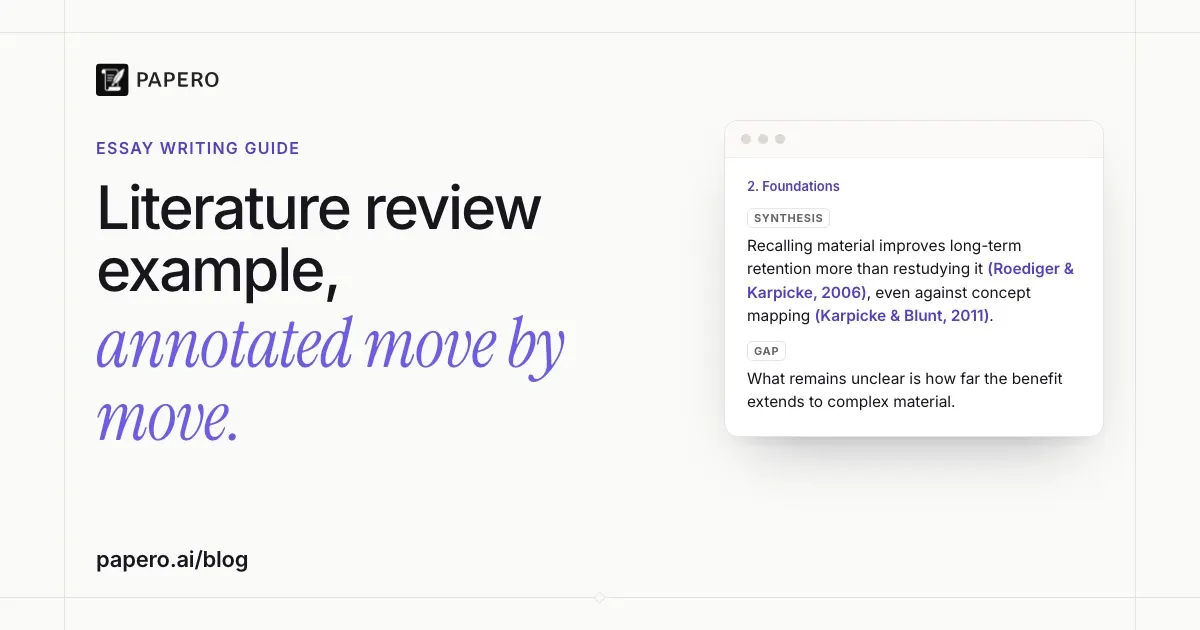
The modern evidence base rests on two laboratory studies. Roediger and Karpicke (2006) found that students who restudied a passage did better on a test five minutes later, but students who had been tested on it retained substantially more after two days and after one week (56% of the material recalled after a week, against 42% for restudying). Karpicke and Blunt (2011) compared retrieval practice with a demanding alternative, building concept maps, and found that retrieval produced more learning a week later, including on inference questions and even when the final test asked students to draw a concept map. Together, these studies suggest the benefit comes from the act of retrieval itself rather than from extra time with the material.
Meta-analyses confirm that the effect is general. Rowland (2014) combined 159 effect sizes from 61 studies and found a moderate advantage for testing over restudying (g = 0.50), larger when learners received feedback (g = 0.73) than when they did not (g = 0.39). Adesope et al. (2017) analysed 272 effect sizes from 118 articles and found a similar advantage when practice tests were compared with restudying (g = 0.51), and Yang et al. (2021), restricting their analysis to classroom studies, found g = 0.499 across 222 studies and 48,478 students. Three reviews with different inclusion rules landing near half a standard deviation is stronger evidence than any single experiment.
Classroom research points the same way. Agarwal et al. (2021) systematically coded 50 experiments in real classrooms and found that 57% of the resulting effect sizes showed medium or large benefits; the benefit held across education levels and subject areas. Concerns that frequent testing raises anxiety have also been examined: in a survey of 1,408 middle and high school students, 72% of those whose classes used retrieval practice reported that it made them less nervous for unit tests and exams (Agarwal et al., 2014).
The effect’s limits are less settled. Introducing a special issue on the question, van Gog and Sweller (2015) argued that the testing effect decreases and may even disappear as learning materials become more complex, that is, when many elements must be processed together. Karpicke and Aue (2015) replied that the effect is alive and well with complex materials: in their reading, the experiments that found no benefit failed because of how retrieval was practised, and complexity itself was never defined in a measurable way. Part of the disagreement therefore turns on what counts as complex material, a term the two sides use differently.
Taken together, the research supports retrieval practice for remembering facts and for applying them to new questions, in laboratories and in classrooms. What remains unclear is how far the benefit extends to highly complex, interconnected material, and the field lacks an agreed, measurable definition of complexity that would let studies on each side be compared. Settling that definition matters most to the students who study such material.
References
Adesope, O. O., Trevisan, D. A., & Sundararajan, N. (2017). Rethinking the use of tests: A meta-analysis of practice testing. Review of Educational Research, 87(3), 659-701. https://doi.org/10.3102/0034654316689306
Agarwal, P. K., D’Antonio, L., Roediger, H. L., III, McDermott, K. B., & McDaniel, M. A. (2014). Classroom-based programs of retrieval practice reduce middle school and high school students’ test anxiety. Journal of Applied Research in Memory and Cognition, 3(3), 131-139. https://doi.org/10.1016/j.jarmac.2014.07.002
Agarwal, P. K., Nunes, L. D., & Blunt, J. R. (2021). Retrieval practice consistently benefits student learning: A systematic review of applied research in schools and classrooms. Educational Psychology Review, 33(4), 1409-1453. https://doi.org/10.1007/s10648-021-09595-9
Dunlosky, J., Rawson, K. A., Marsh, E. J., Nathan, M. J., & Willingham, D. T. (2013). Improving students’ learning with effective learning techniques: Promising directions from cognitive and educational psychology. Psychological Science in the Public Interest, 14(1), 4-58. https://doi.org/10.1177/1529100612453266
Karpicke, J. D., & Aue, W. R. (2015). The testing effect is alive and well with complex materials. Educational Psychology Review, 27(2), 317-326. https://doi.org/10.1007/s10648-015-9309-3
Karpicke, J. D., & Blunt, J. R. (2011). Retrieval practice produces more learning than elaborative studying with concept mapping. Science, 331(6018), 772-775. https://doi.org/10.1126/science.1199327
Roediger, H. L., III, & Karpicke, J. D. (2006). Test-enhanced learning: Taking memory tests improves long-term retention. Psychological Science, 17(3), 249-255. https://doi.org/10.1111/j.1467-9280.2006.01693.x
Rowland, C. A. (2014). The effect of testing versus restudy on retention: A meta-analytic review of the testing effect. Psychological Bulletin, 140(6), 1432-1463. https://doi.org/10.1037/a0037559
van Gog, T., & Sweller, J. (2015). Not new, but nearly forgotten: The testing effect decreases or even disappears as the complexity of learning materials increases. Educational Psychology Review, 27(2), 247-264. https://doi.org/10.1007/s10648-015-9310-x
Yang, C., Luo, L., Vadillo, M. A., Yu, R., & Shanks, D. R. (2021). Testing (quizzing) boosts classroom learning: A systematic and meta-analytic review. Psychological Bulletin, 147(4), 399-435. https://doi.org/10.1037/bul0000309
How the example works, paragraph by paragraph
Each paragraph of the example does one job, and the jobs come in an order you can reuse for almost any topic. The table names the move each paragraph makes and what to copy from it. The pattern matters more than the subject: swap retrieval practice for your own topic and the same six moves still apply.
| Paragraph | Move | What to copy |
|---|---|---|
| 1. Scope | States the problem, cites one authoritative source, then names the focus of the review | End the opening with a sentence that says exactly what the review covers and what it leaves out |
| 2. Foundations | Presents the two studies the field is built on, then says what they show together | Close every theme paragraph with your own sentence that interprets the studies |
| 3. Consolidation | Uses meta-analyses to show the finding is general | Compare reviews by their methods (“different inclusion rules”), not only by their numbers |
| 4. Application | Moves from the laboratory to real classrooms and deals with a likely objection (anxiety) | Answer the question your reader is about to ask |
| 5. Disagreement | Sets two positions side by side and names the cause of the conflict | Explain why researchers disagree; do not only report that they do |
| 6. Gap | Summarises what is known, then states what is not and why it matters | Make the gap follow from the disagreement you described, so it reads as earned |
Two smaller habits run through the whole example. Studies are introduced by what they found, not by who wrote them (“Meta-analyses confirm that the effect is general”, not “Rowland (2014) did a study”). And almost every paragraph ends with a sentence that belongs to the writer, not to a source. Those closing sentences are where a review becomes an argument. The reference list follows APA format; in a document, each entry takes a hanging indent, which the blog cannot show.
Summary vs synthesis: the same sources written two ways
Summary describes sources one at a time, in the order you read them. Synthesis groups sources by what they show and compares them in the same sentence. The difference is easiest to see with identical material, so here are three of the studies from the example, written both ways.
Summary (weak): Roediger and Karpicke (2006) studied students reading prose passages and found that testing improved retention after a week. Karpicke and Blunt (2011) compared retrieval practice with concept mapping. Rowland (2014) did a meta-analysis of the testing effect and found a moderate effect.
Synthesis (strong): Laboratory experiments show that recalling material improves long-term retention more than restudying it (Roediger & Karpicke, 2006), even when the comparison is a demanding activity such as concept mapping (Karpicke & Blunt, 2011). A meta-analysis of 159 effect sizes confirms that the advantage is general rather than a feature of these designs (Rowland, 2014).
The summary version tells the reader what each author did. The synthesis version makes a claim, then shows how three studies build it together, and it is shorter. If your draft has paragraphs that start with an author’s name, that is usually a summary paragraph waiting to be rewritten around an idea. The glossary entry on research synthesis covers the technique in more depth.
How do you write a literature review like this one?
Narrow the question, find and screen the sources, record what each one found in a matrix, group the findings into themes, and draft one theme per paragraph, ending on the gap. The matrix is the step most students skip, and it is the one that turns a pile of PDFs into a structure. Here is the process in six steps.
- Narrow the question. “Retrieval practice” is a topic; “does retrieval practice work outside the lab and with complex material?” is a question a review can answer.
- Search and screen. Search scholarly databases with your key terms, read abstracts, and keep only studies that address your question. Our glossary explains how to build a search strategy.
- Build a synthesis matrix. One row per source, one column per thing you want to compare. The themes of your review appear as patterns in the columns.
- Group into themes. Each theme becomes a paragraph or section. Order them so each one builds on the last.
- Draft by theme, then write the gap. Lead each paragraph with a claim about the research, support it with several sources, close with your interpretation.
- Check every citation against its source. Open each paper and confirm it says what your sentence claims, on the page you cite.
Here is the matrix behind part of the example. Notice how the “Theme” column already contains the paragraph structure.
| Source | Setting | Compared with | Main finding | Theme |
|---|---|---|---|---|
| Roediger & Karpicke (2006) | Laboratory | Restudying | Testing improved retention at 2 days and 1 week | Foundations |
| Karpicke & Blunt (2011) | Laboratory | Concept mapping | Retrieval beat concept mapping one week later | Foundations |
| Rowland (2014) | Meta-analysis | Restudying | g = 0.50 across 159 effect sizes; larger with feedback | Consolidation |
| Agarwal et al. (2021) | Classrooms | Varied | 57% of 49 effect sizes medium or large | Application |
| van Gog & Sweller (2015) | Editorial review | Not applicable | Effect may shrink or vanish with complex material | Disagreement |
The same structure scales. A dissertation chapter has more sources per theme and more themes, but each section still makes a claim, compares studies and ends on what the field has not settled. The glossary entry on the research gap explains how to frame that last part.
What are the 5 C’s of a literature review?
The 5 C’s are cite, compare, contrast, critique and connect: five things every paragraph of a literature review should do with its sources. Writing centres such as Texas Tech University’s teach the list, and open textbooks such as the University of Queensland’s attribute it to Callahan (2014). It works as a checklist for revising a draft, paragraph by paragraph.
| C | What it asks of a paragraph | Where it happens in the example |
|---|---|---|
| Cite | Name the studies the claim rests on | Every paragraph, in APA 7 |
| Compare | Show where studies agree | Paragraph 3: three meta-analyses near half a standard deviation |
| Contrast | Show where studies differ | Paragraph 5: van Gog and Sweller against Karpicke and Aue |
| Critique | Judge the evidence, not only report it | Paragraph 5: names the cause of the conflict, an undefined term |
| Connect | Link the research to your own question | Paragraph 6: the gap the review ends on |
If a paragraph of your draft only cites, it is a summary. Compare and contrast are what make it synthesis, and critique and connect are what make it yours.
Can ChatGPT write a literature review?
A general chatbot can produce text that looks like a literature review, but its references cannot be taken on trust. In a 2023 study, Walters and Wilder asked ChatGPT for short literature reviews on 42 topics: 55% of the citations from GPT-3.5 and 18% from GPT-4 were fabricated, meaning the works did not exist. A fabricated reference in submitted work is an academic integrity problem whether or not you meant it.
Many of the real citations in that study had errors too, and newer models still need the same check. The safe pattern is the reverse of asking a chatbot for sources: start from papers you have found and read, and use tools only to help you organise, compare and check them. Whatever tool you use, the rule from the steps above still holds. Open every source, and confirm it says what your sentence says.
Where Papero fits
Papero is an AI writing workspace for students and researchers, and it is open: you can sign up free. It is built around the problem the previous section describes. According to the Papero homepage, it helps you outline, draft and rewrite your paper, and its citations come from real scholarly records you choose, not from a model’s memory.
Three features line up with the steps in this guide. The outline builder gives you a two-level outline with a prompt for every section, a starting point for grouping studies by theme. Citation search finds papers for the sentence you are writing or looks one up by DOI, and one citation can hold several sources, which is how a synthesis sentence is cited. And the references come out in APA 7, MLA 9, Chicago author-date, Harvard or IEEE, with a Word export at the end. The reading, the writing and the judgment stay yours.
Frequently Asked Questions
How long should a literature review be?
There is no fixed length; follow your brief. A literature review for a class assignment is often a few pages, while a thesis chapter can run to tens of pages. As one reference point, the annotated sample literature review published by James Madison University’s Writing Center was set at 4 to 5 double-spaced pages, which the assignment describes as slightly longer than the literature review in a typical journal article.
How many sources does a literature review need?
Enough to represent the research on your question fairly, which depends on the level and the field. The example above uses ten sources in under 600 words. A dissertation review may cite a hundred or more. If your brief gives no number, ask yourself whether a specialist would notice a missing study, rather than counting.
What is the difference between a literature review and an annotated bibliography?
An annotated bibliography lists sources one by one, each with a short summary or evaluation. A literature review combines the same kind of sources into an argument organised by theme. The bibliography is often a step towards the review: our annotated bibliography example annotates four of the studies used here. See the glossary entry on the annotated bibliography for the format.
Does a literature review need an introduction and a conclusion?
Yes. Even a short review needs an opening that defines the scope and a closing that states what the research shows and what it leaves open. In a dissertation or article, the literature review often sits inside a larger introduction, so its conclusion becomes the bridge to your research question. For more on openings, see our guide to essay introduction examples. If your assignment asks you to argue a position rather than review research, our argumentative essay outline is the better starting point. A review submitted as a paper may also need an abstract; one of our abstract examples summarizes this review.
Sources
- Every study in the example is listed with its DOI in the example’s reference list above.
- Walters, W. H., & Wilder, E. I. (2023). Fabrication and errors in the bibliographic citations generated by ChatGPT. Scientific Reports, 13, Article 14045. https://doi.org/10.1038/s41598-023-41032-5
- University of Queensland, Quality in Healthcare: Assessing What We Do (open textbook), “The 5 Cs of a literature review”, which credits the list to Callahan, J. L. (2014), Writing literature reviews: A reprise and update, Human Resource Development Review, 13(3), 271-275 (uq.pressbooks.pub, accessed October 2026): https://uq.pressbooks.pub/quality-in-healthcare/chapter/5-cs-literature-review/
- Texas Tech University Writing Center, Writing a Literature Review (ttu.edu, accessed October 2026): https://www.depts.ttu.edu/provost/uwc/graduate/writing-resources/writing-a-literature-review.php
- James Madison University Writing Center, About this sample literature review (annotated sample, jmu.edu, accessed October 2026): https://www.jmu.edu/uwc/files/link-library/annotated-literature-review.pdf