AMA citation style numbers your sources in the order you first cite them. In the text, each source is marked with a superscript arabic numeral, and the reference list at the end, titled References, lists the sources in that same numerical order, not alphabetically. The rules come from the AMA Manual of Style, 11th edition (2020). AMA style is used by JAMA and its sister journals and is a common requirement in medicine, nursing, pharmacy and the health sciences.
Key Takeaways
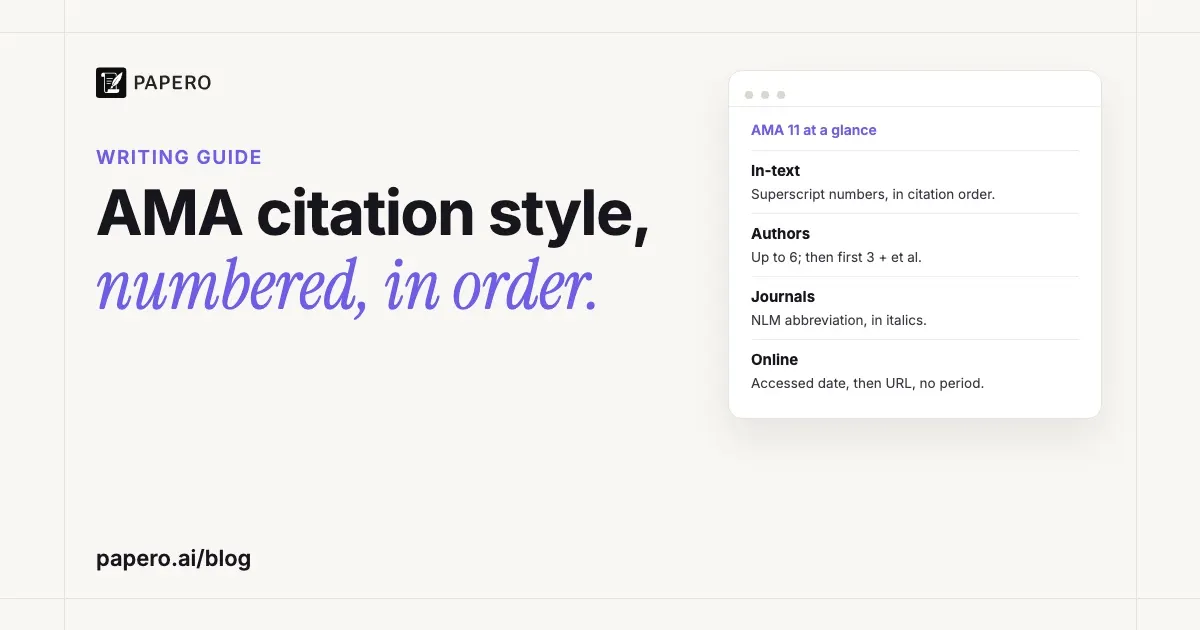
- In-text: superscript numbers, assigned in order of first citation, placed outside periods and commas and inside colons and semicolons.
- A source keeps its first number every time you cite it again; add a page as 2(p226) when you need one.
- Authors: list all of them up to 6; with 7 or more, list the first 3 and then et al (no period of its own in AMA).
- Journal names are abbreviated as in the NLM Catalog and set in italics: N Engl J Med, not New England Journal of Medicine.
- The 11th edition dropped the publisher’s city, moved URLs to the end and put no period after a DOI or URL.
AMA citation format: reference examples by source type
An AMA reference gives the authors as surname plus initials with no periods, then the title, then the source details. Article and chapter titles are in sentence case; journal names are abbreviated and italic, and book titles are italic in title case. Journal entries pack the year, volume, issue and pages into one string: 2014;312(17):1772-1778. Every example below is a real work, checked against its PubMed, Crossref or publisher record in October 2026.
| Source | AMA 11 reference entry |
|---|---|
| Journal article, 6 authors | Youngster I, Russell GH, Pindar C, Ziv-Baran T, Sauk J, Hohmann EL. Oral, capsulized, frozen fecal microbiota transplantation for relapsing Clostridium difficile infection. JAMA. 2014;312(17):1772-1778. doi:10.1001/jama.2014.13875 |
| Journal article, 7 or more authors | Polack FP, Thomas SJ, Kitchin N, et al; C4591001 Clinical Trial Group. Safety and efficacy of the BNT162b2 mRNA Covid-19 vaccine. N Engl J Med. 2020;383(27):2603-2615. doi:10.1056/NEJMoa2034577 |
| Article with an article number | Ioannidis JPA. Why most published research findings are false. PLoS Med. 2005;2(8):e124. doi:10.1371/journal.pmed.0020124 |
| Book | Iverson C, Christiansen S, Flanagin A, et al. AMA Manual of Style: A Guide for Authors and Editors. 11th ed. Oxford University Press; 2020. |
| Chapter in an edited book | Schulz S, Stegwee R, Chronaki C. Standards in healthcare data. In: Kubben P, Dumontier M, Dekker A, eds. Fundamentals of Clinical Data Science. Springer; 2019:19-36. doi:10.1007/978-3-319-99713-1_3 |
| Website | International Committee of Medical Journal Editors. Recommendations for the conduct, reporting, editing, and publication of scholarly work in medical journals. Updated January 2026. Accessed October 29, 2026. https://www.icmje.org/recommendations/ |
| Government report | Office of the Surgeon General. Our Epidemic of Loneliness and Isolation: The U.S. Surgeon General’s Advisory on the Healing Effects of Social Connection and Community. US Dept of Health and Human Services; 2023. Accessed October 29, 2026. https://www.hhs.gov/sites/default/files/surgeon-general-social-connection-advisory.pdf |
The Youngster entry is the first example in JAMA’s Instructions for Authors, with the DOI added; with exactly six authors, all six are listed. The Polack paper has more than six, so only the first three appear, and its trial group follows et al after a semicolon. PLoS Medicine numbers its articles, so e124 sits where the pages would. The book and website entries copy the shape of the reference list at the end of JAMA’s instructions. That list cites the AMA manual with no city of publication, as our book entry does, and the ICMJE recommendations with an updated date, an accessed date and the URL, in that order. We changed only the dates and used the https address, and we left out the manual’s website URL.
Government reports are where guides disagree most. Great Falls College MSU’s template treats a report like a web page (agency, title, dates and URL, with no publisher), though its notes say to use book style for monographs. Purdue OWL’s AMA page on print sources puts the issuing agency where the publisher goes, with “Department” shortened to “Dept”, but its examples still name a city, which the AMA Style Insider says the 11th edition drops for books and reports. The entry above treats the advisory as a book: agency as author, italic title, the department as publisher, no city. The ICMJE entry has no separate website name because the committee is both author and site owner, the shape JAMA uses for it.
How do you write an AMA in-text citation?
Put a superscript arabic numeral right after the fact, idea or quotation you are citing. The first source you cite is 1, the next new one is 2, and so on. The number goes outside periods and commas but inside colons and semicolons. To cite several sources at once, separate the numbers with commas and no spaces, and join three or more consecutive numbers with a hyphen: 1,3-5.
JAMA’s instructions state the core rule in two sentences: number references in the order they appear in the text, without alphabetizing, and identify them with superscript arabic numerals in the text, tables and legends. The placement rules come from Purdue OWL and the University of Washington’s health sciences library guide:
| Situation | AMA in-text citation |
|---|---|
| End of a sentence | …in older adults.1 |
| Before a comma | …in older adults,1 but not in children. |
| Before a semicolon or colon | …in older adults1; others disagree. |
| Two sources | …in older adults.1,4 |
| A run of sources | …in older adults.1-3,5 |
| Author named in the sentence | Fontanarosa et al2 wrote that… |
When you name authors in your sentence, the number still goes in. Use the surname alone for one author, both surnames for two, and the first surname plus “et al” for three or more. AMA writes “et al” without a period of its own: in running text, as the Purdue OWL and University of Washington examples show, and in references, as JAMA’s own entries show. Purdue OWL also warns against putting a superscript right after a number, where it could be read as an exponent: rewrite the sentence instead.
Here is a short worked paragraph and the reference list it produces:
Authorship carries responsibility as well as credit. The ICMJE bases authorship on four criteria,1 and a 2017 JAMA article by Fontanarosa et al2 looked at authorship in team science. A single vaccine trial can list dozens of authors3; the 2005 essay “Why most published research findings are false” has one.4 Under the ICMJE criteria, every listed author must meet all four, however long the byline.1
References
- International Committee of Medical Journal Editors. Recommendations for the conduct, reporting, editing, and publication of scholarly work in medical journals. Updated January 2026. Accessed October 29, 2026. https://www.icmje.org/recommendations/
- Fontanarosa P, Bauchner H, Flanagin A. Authorship and team science. JAMA. 2017;318(24):2433-2437. doi:10.1001/jama.2017.19341
- Polack FP, Thomas SJ, Kitchin N, et al; C4591001 Clinical Trial Group. Safety and efficacy of the BNT162b2 mRNA Covid-19 vaccine. N Engl J Med. 2020;383(27):2603-2615. doi:10.1056/NEJMoa2034577
- Ioannidis JPA. Why most published research findings are false. PLoS Med. 2005;2(8):e124. doi:10.1371/journal.pmed.0020124
The ICMJE recommendations are number 1 because the paragraph cites them first; in alphabetical order, Fontanarosa would lead. They keep number 1 when the last sentence cites them again.
How do you cite the same source twice or a specific page?
Reuse the number the source got the first time you cited it, for as long as the paper runs; never give one source two numbers or put two sources under one number. When you need a page, for a direct quotation or a specific figure, add it in parentheses inside the superscript, after the number: 2(p226) for one page, 2(pp567-569) for a range.
That page form is what JAMA uses in its own Instructions for Authors, where the AMA manual is reference 2 and is cited as 2(p226), 2(p199) and 2(pp567-569) on different topics, with no period after the “p”. Widener University’s AMA guide adds that direct quotations should carry a page number. One source, one number, many pages: the reference list entry stays the same and only the superscript changes.
Some sources stay out of the numbered list. JAMA’s instructions say personal communications, such as an email or a conversation, are added to the text in parentheses and not included in the list of references. Purdue OWL treats unpublished material the same way.
How many authors do you list in an AMA reference?
List every author when there are six or fewer. When there are seven or more, list the first three followed by et al, which AMA writes without a period of its own. Each name is the surname followed by initials with no periods or spaces, as in Ioannidis JPA, and names are separated by commas.
Count carefully, because the rule is easy to misread. A paper with exactly six authors keeps all six, as the Youngster entry does; only the seventh author tips it into “first three plus et al”. One library guide in the current top results phrases the cutoff as “6 or more”, which would cut a six-author paper short. JAMA’s wording, for authors and editors alike, is “List all authors and/or editors up to 6; if more than 6, list the first 3” followed by et al.
A group can be an author too. The ICMJE entry above starts with the committee’s full name, and the Polack entry shows the other case: named authors first, then the group after et al and a semicolon, as JAMA’s own reference list does. Suffixes follow the initials without a comma, as in Jameson JJ Jr, the example Purdue OWL gives.
How do you abbreviate journal names in AMA style?
Use the abbreviation the US National Library of Medicine assigns to the journal, and set it in italics. JAMA’s instructions tell authors to abbreviate journal names according to the journals list in PubMed. The NLM Catalog shows each journal’s abbreviation; a journal whose name is a single word, such as Neurology, is not shortened at all.
| Full journal title | NLM abbreviation (as used in AMA) |
|---|---|
| JAMA | JAMA |
| The New England Journal of Medicine | N Engl J Med |
| PLoS Medicine | PLoS Med |
| JAMA Network Open | JAMA Netw Open |
The abbreviations carry no periods. After the journal name comes a period, then the year, a semicolon, the volume, the issue in parentheses, a colon and the page range: JAMA. 2017;318(24):2433-2437. JAMA asks for the issue number in every journal reference, and Purdue OWL’s AMA print page says to keep every digit in a page range, so 2433-2437, never 2433-7. To look one up, search the journal’s full title in the NLM Catalog and copy its abbreviation as shown; do not invent one from a pattern.
How do you format DOIs, URLs and access dates in AMA 11?
Give the DOI at the end of the reference, written as doi: followed by the number with no space and no period after it. A DOI replaces the URL and the access date. Without a DOI, an online source ends with “Accessed” and the date you viewed it, then the URL, again with no period. Published and updated dates go before the accessed date.
The “doi:10.1001/jama.2014.13875” form is what JAMA’s own reference list prints, and Purdue OWL’s electronic sources page says that when a DOI is available, AMA recommends it in place of a URL. The University of South Alabama library’s summary of the 11th edition’s changes says both DOIs and URLs are no longer followed by a period, and Widener University’s guide repeats the point for every online example.
What changed in the AMA 11th edition?
The 11th edition, published in 2020, changed three things about references that you can see at a glance: the publisher’s city and state are gone from book entries, the URL moved from the middle of an online reference to the very end, after the accessed date, and DOIs and URLs no longer end with a period. Older guides that still show a city of publication are showing 10th-edition style.
| Detail | AMA 10th edition | AMA 11th edition |
|---|---|---|
| Book publisher | New York, NY: McGraw Hill Medical; 2011. | Oxford University Press; 2020. |
| Online reference | …URL. Accessed Month Day, Year. | …Accessed Month Day, Year. URL |
| DOI or URL at the end | Followed by a period | No period |
The AMA’s own blog, AMA Style Insider, announced the first two changes. An early post by Heather Green, in 2018, previewed both: URLs moving to the end of the reference, “similar to how DOIs currently appear,” and publisher locations dropped from books and reports. A 2020 post by Amanda Ehrhardt confirms that the publisher’s location is no longer required for books and edited books (section 3.12.8 of the manual) and that the publisher now follows the title directly.
Even the publisher’s free pages lag. JAMA’s Instructions for Authors (last updated September 2026) still show a book example with “New York, NY: McGraw Hill Medical”, while the reference list at the bottom of the same page cites the AMA manual in 11th-edition form. Copy from that list. The same check works on any guide: an example that names the city, or puts the URL before the accessed date, follows the 10th edition.
AMA vs Vancouver vs APA: what is the difference?
AMA and Vancouver are both numbered styles used in medicine: sources are numbered in order of first citation and listed in that order. They differ in the details. AMA uses superscript numbers, italic journal abbreviations and full page ranges, and it cuts a list of more than 6 authors to the first 3 plus et al, where Vancouver keeps 6. APA 7 is an author-date style with an alphabetical reference list.
| Feature | AMA 11 | Vancouver (ICMJE/NLM) | APA 7 |
|---|---|---|---|
| In-text | Superscript number | Number in parentheses (ICMJE) | (Author, year) |
| Reference order | Order of first citation | Order of first citation | Alphabetical by first word |
| More than 6 authors | First 3, then et al | First 6, then et al. | Up to 20 named |
| Journal title | Abbreviated, italic | Abbreviated, not italic | Full title, italic |
| Page range | 284-287 | 284-7 | 284–287 |
The Vancouver column follows the ICMJE recommendations, which ask for “Arabic numerals in parentheses” in the text, and the NLM’s Samples of Formatted References, which lists the first six authors and shortens page ranges (284-7). Many journals and universities adapt Vancouver, so check which version your course uses; our Vancouver style glossary entry has a short overview, and our Vancouver referencing guide covers the NLM version in full, with 11 reference examples across eight source types. APA works differently from the ground up: it cites by author and year, so moving a paragraph never renumbers anything. Our guide to APA in-text citations covers that system.
In a numbered style, adding a source mid-draft shifts every later number. Widener University’s AMA guide suggests, as practical advice rather than a rule of the style, drafting with short placeholders such as an author’s name and numbering once the text is final. That helps most in source-heavy work like a literature review, where one moved paragraph can renumber dozens of citations. The same renumbering happens in IEEE, the numbered style of engineering and computer science, which writes the numbers on the line in square brackets instead of as superscripts; our IEEE citation format guide shows it.
Where Papero fits
Papero is an AI writing workspace for students and researchers. It finds real papers to cite for the sentence you are writing, looks sources up by DOI, PMID, arXiv ID or ISBN, and formats the in-text citations and the reference list in AMA 11 or one of eight other styles, including Vancouver and APA 7.
JAMA’s instructions now add that AI, LLM and chatbots should not be used to generate or format references, and that standard reference managers may be used instead. Papero’s formatting step is not a language model: it runs citeproc-js, an open-source citation engine, with the Citation Style Language’s file for the AMA Manual of Style 11th edition, so in-text citations are superscript numbers in the editor and in the Word export, and a source with seven or more authors is cut to the first three plus et al. JAMA’s rule also covers generating references, so for a JAMA Network submission choose and check each source yourself, and report any AI use as its instructions require: JAMA wants it in the Acknowledgment rather than cited, and our guide to citing ChatGPT sets that next to the APA, MLA and Chicago formats. On the free plan, in-text citations work in full and the reference list shows your entries blurred; Plus makes it readable, copyable and exportable (papero.ai/pricing). For a few references without an account, the free PMID to citation generator and the DOI to citation generator take up to 10 identifiers at a time and offer AMA among nine styles. Check every entry against the rules above, especially journal abbreviations (when a record has no short title, the output prints the full journal name), and confirm that any reference you did not find yourself exists: our guide to spotting fake AI references shows how. The research paper writing page shows the whole workflow, and you can sign up free.
Frequently Asked Questions
What edition of AMA style should I use?
Use the 11th edition of the AMA Manual of Style, published in 2020, unless your instructor or journal names another. It is the edition JAMA’s Instructions for Authors cite. Its reference entries leave out the publisher’s city, put the URL at the end after the accessed date and drop the period after a DOI or URL.
Does AMA in-text citation go before or after the period?
After. In AMA style the superscript number goes outside periods and commas, so it follows them: “…in older adults.1” It goes inside colons and semicolons, so it comes before them: “…in older adults1; others disagree.”
How do you cite a website with no author in AMA?
Start the entry with the title of the page, followed by the name of the website. Then give the published or updated date if the page shows one, the word “Accessed” with the date you viewed it, and the URL with no period after it. When an organization wrote the page, its name can go first, as the author.
Does AMA citation use et al?
Yes, in two places, and AMA writes “et al” with no period of its own. In the reference list, a work with seven or more authors lists the first three authors and then et al. In the text, a work with three or more authors is named by the first author’s surname plus et al, followed by the superscript number.
Is AMA the same as Vancouver style?
No, though both are numbered styles from medicine. AMA uses superscript numbers, italic journal abbreviations, full page ranges and three authors before et al. Vancouver, as the ICMJE recommendations and the US National Library of Medicine’s sample references show it, uses numbers in parentheses in the text (ICMJE), journal abbreviations without italics, shortened page ranges and six authors before et al (NLM).
Sources
- JAMA Network, “Instructions for Authors” (jamanetwork.com, last updated September 8, 2026, accessed October 2026 through the Internet Archive): https://jamanetwork.com/journals/jama/pages/instructions-for-authors
- Amanda Ehrhardt, “Where in the World Is the Publisher’s Location?” (AMA Style Insider, May 1, 2020): https://amastyleinsider.com/blog/2020/05/01/where-in-the-world-is-the-publishers-location
- Heather Green, “Looking Forward to the 11th Edition” (AMA Style Insider, December 3, 2018): https://amastyleinsider.com/blog/2018/12/03/looking-forward-11th-edition
- Purdue OWL, “AMA Style” introduction, “Print Sources” and “Electronic Sources” (owl.purdue.edu, 11th edition, accessed October 2026): https://owl.purdue.edu/owl/research_and_citation/ama_style/index.html
- University of Washington Libraries, “In-Text Citations”, AMA Style Guide (guides.lib.uw.edu, accessed October 2026): https://guides.lib.uw.edu/hsl/ama/intext
- Widener University, “How to Cite…” and “In-Text Citations”, AMA Style Guide (widener.libguides.com, accessed October 2026): https://widener.libguides.com/AMAstyle/InTextCitation
- University of South Alabama Libraries, “AMA: Notable Changes from the 10th to 11th Edition” (PDF, accessed October 2026): https://mym.cdn.usa.edu/USA/Library/AMA_changes_from_10th_to_11h_Edition.pdf
- Great Falls College MSU, “AMA Style”, Citation Quick Guide (research.gfcmsu.edu, accessed October 2026): https://research.gfcmsu.edu/CitationQuickGuide/AMA
- National Library of Medicine, NLM Catalog (journal abbreviations, accessed October 2026): https://www.ncbi.nlm.nih.gov/nlmcatalog/journals
- National Library of Medicine, “Samples of Formatted References for Authors of Journal Articles” (nlm.nih.gov, last reviewed June 2, 2026): https://www.nlm.nih.gov/bsd/uniform_requirements.html
- International Committee of Medical Journal Editors, “Preparing a Manuscript for Submission to a Medical Journal” and “Defining the Role of Authors and Contributors” (icmje.org, Recommendations updated January 2026): https://www.icmje.org/recommendations/browse/manuscript-preparation/preparing-for-submission.html
- American Psychological Association, “Author–date citation system” and “Reference list setup” (apastyle.apa.org, accessed October 2026 through the Internet Archive): https://apastyle.apa.org/style-grammar-guidelines/citations/basic-principles/author-date
- Youngster I, Russell GH, Pindar C, Ziv-Baran T, Sauk J, Hohmann EL. Oral, capsulized, frozen fecal microbiota transplantation for relapsing Clostridium difficile infection. JAMA. 2014;312(17):1772-1778. https://doi.org/10.1001/jama.2014.13875
- Polack FP, Thomas SJ, Kitchin N, et al; C4591001 Clinical Trial Group. Safety and efficacy of the BNT162b2 mRNA Covid-19 vaccine. N Engl J Med. 2020;383(27):2603-2615. https://doi.org/10.1056/NEJMoa2034577
- Ioannidis JPA. Why most published research findings are false. PLoS Med. 2005;2(8):e124. https://doi.org/10.1371/journal.pmed.0020124
- Fontanarosa P, Bauchner H, Flanagin A. Authorship and team science. JAMA. 2017;318(24):2433-2437. https://doi.org/10.1001/jama.2017.19341
- Schulz S, Stegwee R, Chronaki C. Standards in healthcare data. In: Kubben P, Dumontier M, Dekker A, eds. Fundamentals of Clinical Data Science. Springer; 2019:19-36. https://doi.org/10.1007/978-3-319-99713-1_3
- Office of the Surgeon General. Our Epidemic of Loneliness and Isolation: The U.S. Surgeon General’s Advisory on the Healing Effects of Social Connection and Community. US Dept of Health and Human Services; 2023. https://www.hhs.gov/sites/default/files/surgeon-general-social-connection-advisory.pdf