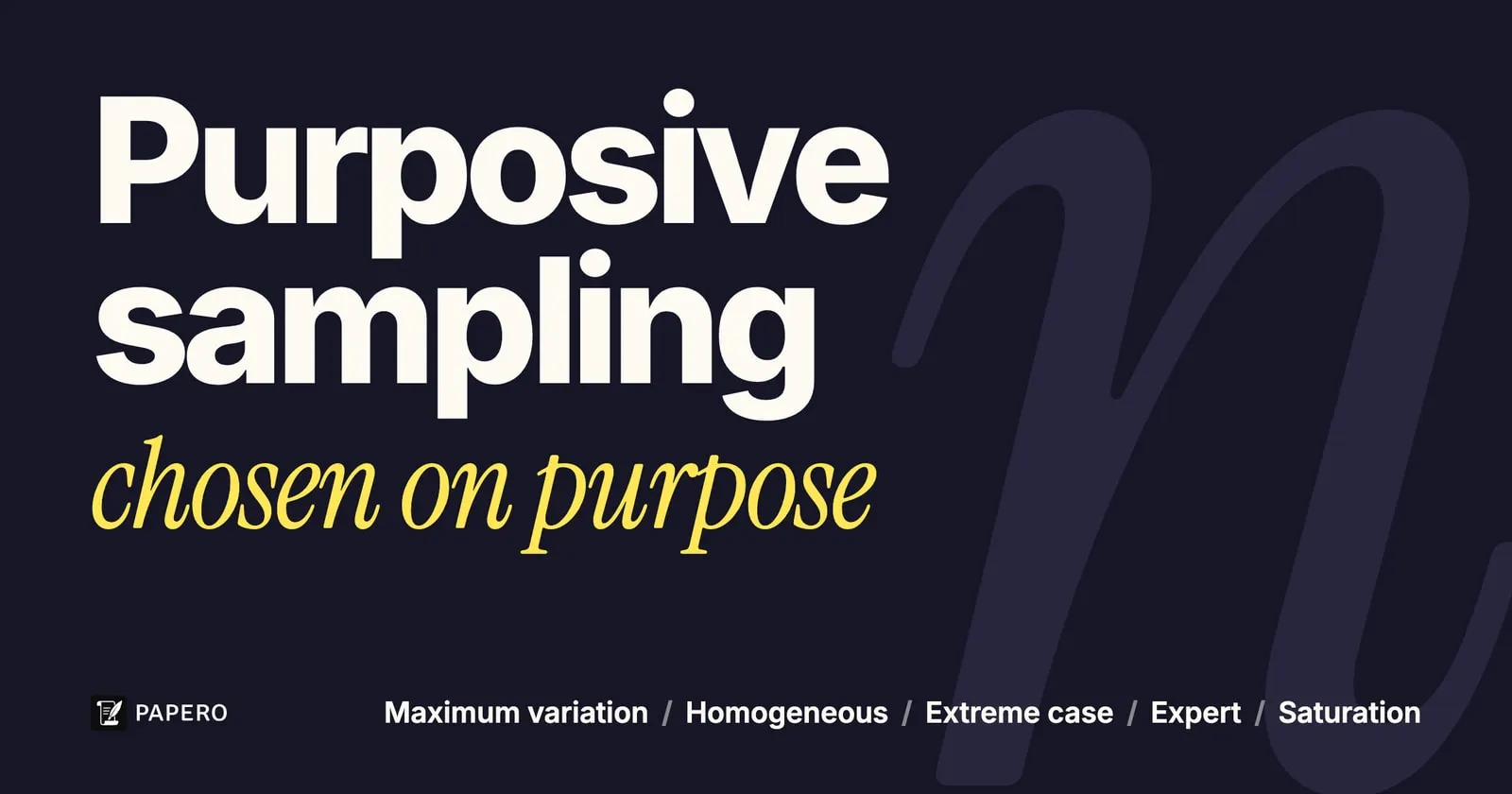
Purposive sampling is a non-probability method in which the researcher deliberately chooses participants because they have the experience, knowledge or traits the research question needs. It is also called judgment (or judgmental) sampling and, in qualitative research, purposeful sampling. This guide pairs each type with a published study that used it, shows how to pick a type, and sets out the evidence on how many participants you need.
Key Takeaways
- A purposive sample is chosen for a reason tied to the research question, not for access (convenience) or by chance (random sampling). State that reason in your methods section.
- Most types fall into two families: those that seek variation (maximum variation, extreme case, intensity) and those that seek similarity (homogeneous, typical case, criterion). Your research question decides which family you need.
- In a review of 28 implementation studies, criterion sampling was the most common type, yet only 5 named purposeful sampling and 20 gave no description of their sampling strategy.
- Tested interview studies reached saturation at 9 to 17 interviews, or 4 to 8 focus groups, mostly with similar participants and narrow questions. Varied samples and broad questions need more.
- Results from a purposive sample describe people with the characteristics you selected for. They do not estimate how common anything is in a wider population.
What is purposive sampling?
Purposive sampling means selecting participants on purpose, because they have the characteristics or experience your study is about. The researcher sets the criteria first, then looks for people or cases that meet them and can describe their experience well. It is the usual approach in interview and focus group research, where the aim is depth of understanding, and it is common in quantitative studies with strict inclusion criteria too.
Definitions differ in emphasis, which is why students searching for a definition by author find several:
- Etikan, Musa and Alkassim (2016): “The purposive sampling technique, also called judgment sampling, is the deliberate choice of a participant due to the qualities the participant possesses.”
- Palinkas and colleagues (2015), following Patton: a technique for “the identification and selection of information-rich cases for the most effective use of limited resources.”
- Andrade (2021): “A purposive sample is the one whose characteristics are defined for a purpose that is relevant to the study.”
- Kelly (2010), as quoted by Campbell and colleagues (2020): a method “used to select respondents that are most likely to yield appropriate and useful information.”
Palinkas’s and Kelly’s versions stress what a participant can tell you; Etikan’s and Andrade’s stress the qualities or criteria that qualify them. Andrade’s version is the broadest of the four. A drug trial that admits only people who have smoked more than ten cigarettes a day for at least a year is, in his terms, a purposive sample, and he adds that “the more purposive the sample is, the more limited the external validity will be.” So the method is not confined to qualitative work.
Types of purposive sampling, each with a real study
The main types are maximum variation, homogeneous, typical case, extreme or deviant case, intensity, critical case, criterion, expert and snowball sampling. They differ in what the researcher looks for: wide differences, close similarity, the ordinary case, the unusual case or specialist knowledge. The table gives each type one published study that used it.
Seven of the nine studies name the type in their own methods; the intensity and snowball examples are as classified by Palinkas et al., who found that the snowball study described no sampling strategy of its own. Most of these labels follow Patton’s typology in Qualitative Research and Evaluation Methods. We could not read that book, so the definitions below follow the version reproduced in Table 1 of Palinkas et al. (2015) and the descriptions in Etikan et al. (2016).
| Type | Who you choose | A study that used it |
|---|---|---|
| Maximum variation | Cases that differ on the dimensions that matter, to find patterns that hold across them | Mosalanejad et al. (2026): 32 medical sciences students at Jahrom University, varied by field, preclinical or clinical stage, gender and performance, interviewed about procrastination and anhedonia |
| Homogeneous | Cases that share one trait, to study it in depth | Moll (2023): 13 employees who had declared a disability at a South African university, on coping with workplace accommodations |
| Typical case | Ordinary cases that show what is normal | Pennathur and Ayres (2018): 34 healthcare workers in typical roles on the units of a typical patient trajectory, on how readmissions change their care |
| Extreme or deviant case | Unusual successes or failures | Yuan et al. (2024): 14 faculty development Fellows from seven sites, nominated as the most successful |
| Intensity | Cases that show the phenomenon strongly, but not at the extremes | Aarons and Palinkas (2007), as described by Palinkas et al.: 15 child welfare case managers with the most positive and most negative views of an intervention, picked from survey results |
| Critical case | The case where, if something holds, it likely holds elsewhere | Granel et al. (2025): nurses with at least 3 years on their unit, in two public hospitals in each of four European countries; 16 interviewed |
| Criterion | Every case that meets a set criterion | Hacıoğlu et al. (2025): 23 women seen at one hospital’s clinic within six months of pregnancy loss or termination |
| Expert | People with specialist knowledge of the topic | Addis et al. (2024): 11 national-level managers of Ethiopia’s immunization program, on barriers to the first measles dose |
| Snowball | Participants who refer others like them | Green and Aarons (2011), as described by Palinkas et al.: program managers named clinicians, support staff and service users to recruit |
Palinkas’s table also lists theory-based sampling, confirming and disconfirming cases, stratified purposeful sampling, purposeful random sampling and opportunistic sampling, and Etikan adds total population sampling, where every case that meets the criteria is included. Campbell and colleagues describe four forms common in multi-case studies: stratified, cell, quota and theoretical sampling.
Read what the authors did, not only the label. Labels drift between papers. Granel and colleagues call their design critical case sampling, but their rule for choosing nurses was experience on the unit, which is closer to a criterion, and they note that their hospitals “were selected for convenience rather than randomisation.” Palinkas and colleagues file Aarons and Palinkas’s case managers, chosen for the most positive and most negative views, under intensity sampling, although picking the two ends of a survey is close to extreme case sampling. Moll calls her sample homogeneous, and it was: everyone had declared a disability. It was also everyone who answered an email invitation, all 13 volunteers. Campbell and colleagues say plainly that all three of their own purposive studies had “a convenience element” because consent is voluntary. When you cite a study as an example of a type, check its methods section for how people were actually found.
How do you choose a type from your research question?
Start from what your question asks you to compare. A question about how an experience differs across groups or settings needs variation: maximum variation, extreme case or intensity sampling. A question about what one experience is like needs similarity: homogeneous, typical case or criterion sampling. A question that only a few informed people can answer points to expert sampling.
| If your question asks… | Sample for | Types that fit |
|---|---|---|
| What is it like to go through X? | Similarity | Criterion, homogeneous |
| How does X differ across settings, roles or groups? | Variation | Maximum variation, stratified purposeful |
| Why do some cases of X succeed and others fail? | Contrast at the ends | Extreme or deviant case, intensity |
| What does X normally look like? | The ordinary case | Typical case |
| If X fails here, will it fail anywhere? | A decisive case | Critical case |
| How does the system behind X work? | Knowledge | Expert (key informants) |
| How do people in a group with no list experience X? | Access through networks | Snowball |
| Does my emerging explanation of X hold? | Testing ideas as they form | Theoretical, confirming and disconfirming cases |
Palinkas and colleagues draw the same line: maximum variation, extreme case and intensity sampling “identify and expand the range of variation,” while homogeneous, typical case, criterion and snowball sampling “narrow the range of variation and focus on similarities.” They also warn that criterion sampling alone, the most common choice in the 28 studies they reviewed, “may actually be inadequate” when a study needs both breadth and depth, because selecting people in one role misses what other roles know, while selecting across roles can miss the most knowledgeable people.
For implementation research they recommend combining types in stages. The “funnel approach” samples for variation first, then narrows to similar cases to examine one pattern in depth. A thesis that first interviews teachers from very different schools, then returns to the schools where a new policy worked best, follows that funnel (an invented illustration).
How many participants does a purposive sample need?
There is no power calculation for a purposive sample. The usual stopping rule is saturation: you keep recruiting until new interviews stop adding new codes or themes. Tested studies put that point at 9 to 17 interviews or 4 to 8 focus groups for fairly similar participants and a narrow question. Plan more for a varied sample, a broad question or several sites.
The evidence comes from studies that tracked saturation directly, and from precedents by method:
- Guest, Bunce and Johnson (2006) analysed 60 in-depth interviews with women in two West African countries and tracked saturation over the course of their analysis. They report that “saturation occurred within the first twelve interviews, although basic elements for metathemes were present as early as six interviews.”
- Hennink and Kaiser (2022) reviewed 23 articles that tested saturation, 17 with empirical data and 6 with statistical modelling. Studies with empirical data reached saturation within 9 to 17 interviews or 4 to 8 focus group discussions. Most had a fairly homogeneous population and narrowly defined objectives; the outliers, such as multi-country studies, needed larger samples.
- Palinkas et al. (2015) cite precedents by method: 3 to 6 participants interviewed several times in a phenomenological study, against 20 to 30 interviewed once or twice in a grounded theory study.
Depth per person matters as much as headcount. Campbell and colleagues planned about 10 new mothers, each interviewed three or four times over 9 to 12 months, and quote Morse: “There is an inverse relationship between the amount of useable data obtained from each participant and the number of participants.”
What the example studies actually used. The seven studies in the table that we read ourselves recruited 11, 13, 14, 16, 23, 32 and 34 participants, a median of 16. Four fall inside the 9 to 17 range. The two largest are the ones spread across the most groups: 32 students across four disciplines and two stages of training, and 34 healthcare workers across roles and units. That matches Hennink and Kaiser’s point that heterogeneous samples need more people.
Two stopping decisions show saturation in practice. Addis and colleagues planned 30 expert interviews, found no new themes after the 10th, and stopped at 11. Pennathur and Ayres stopped recruiting each role once successive interviews showed saturation, and also used the number of staff available on a unit as a practical limit. Report both kinds of reason in your thesis. The sample size glossary entry covers the probability side, where formulas do apply.
Purposive vs convenience vs random sampling
A purposive sample is chosen for a trait the study needs, a convenience sample for ease of access, and a random sample by chance from a full list. Only random sampling supports statistical estimates for a population. Purposive and convenience samples are both non-probability methods; the difference is that a purposive sample has a stated reason, linked to the research question, for every person in it.
Palinkas’s table includes convenience sampling only to set it apart: “Although commonly used, it is neither purposeful nor strategic.” In practice the two overlap, because recruitment often runs through whoever answers a flyer. Campbell and colleagues describe a planned study that will recruit new mothers through a flyer at one hospital’s antenatal clinic, and argue that the criteria decide the label: “Although there is an element of convenience sampling involved in this process, the very specific nature of the criteria for involvement make this design purposive.” Our guide to convenience sampling shows how far a convenience sample’s estimates can drift and when that matters.
Random and purposive selection are not opposites either. Palinkas lists purposeful random sampling, a random draw from a purposively defined group, used “to increase the credibility of results.” Andrade notes that a random sample from a purposively defined subpopulation supports conclusions about that subpopulation only. If you need population estimates, you need probability sampling from the whole population; the glossary entry on random sampling sets out the designs.
When should you use purposive sampling?
Use it when your question is about understanding an experience, a process or a decision in depth, and only some people can speak to it. Typical cases are interview and focus group studies, case studies, expert consultations, and the qualitative stage of a mixed methods design. Avoid it when you need to say how common something is, or to estimate an average for a whole population.
Advantages. It puts limited interview time into people who can answer the question, which Palinkas calls the most effective use of limited resources. It lets you include small but important groups that random sampling would miss by chance. A homogeneous sample, Andrade adds, reduces variation between participants, and strict criteria keep out people at risk of harm in a trial.
Disadvantages. The researcher’s judgment shapes the sample, so selection bias is possible and has to be argued against openly. Findings do not generalise statistically: Pennathur and Ayres warn that theirs “should not be taken to represent the entire population given this is a purposive sample.” The range of variation is often unknown at the start, so a sample planned for variation can still miss cases. And a narrow sample narrows the claim, the trade-off between depth and reach that our comparison of qualitative and quantitative research explains.
The fix for most of these is reporting, not a different method. Qualitative work judges a sample by transferability: whether readers have enough description of who took part to decide if the findings fit their own setting. Campbell and colleagues link a clear account of criteria and participants directly to transferability, dependability and confirmability.
How to justify a purposive sample in your methods section
State the type, the criteria and the reason the criteria fit your research question. Then say how you found participants, how many you approached and interviewed, and why you stopped. A reader should be able to see who could have been in your sample and who could not. In the review by Palinkas and colleagues, most studies did not meet this standard.
Palinkas and colleagues re-examined 28 mixed methods implementation studies. Only 5 made a specific reference to purposeful sampling, 3 more gave a rationale for their selection, and the other 20 “provided no description of the sampling strategy used.” Their first recommendation is “for researchers to clearly describe their sampling strategies and provide the rationale for the strategy.” Our guide on how to write a methodology section shows where these details sit, and the methodology section glossary entry defines its parts.
Here is a model pair for an invented study of first-generation university students (bracketed parts are placeholders):
Methods: “We used purposive maximum variation sampling to recruit 16 second-year undergraduates who were the first in their family to attend university. To capture different experiences, we sampled across four faculties (arts, sciences, engineering and health) and two entry routes (school leavers and mature students), aiming for at least one participant in each of the eight combinations. Participants were recruited through the student union newsletter and course representatives between [month] and [month, year]. We stopped at 16 interviews because the last three added no new codes to the codebook.”
Limitations: “Participants volunteered through student channels, so the sample may over-represent students who are engaged with campus life. The findings describe first-generation students at one university. They are meant to transfer to similar settings, not to estimate how common any experience is among first-generation students.”
The methods paragraph names the type, the dimensions of variation, the channel and the stopping rule; the limitations paragraph names the likely direction of bias and the scope of the claim. Our guide to the limitations of a study has more published wording, and the guide to sampling bias explains how volunteer and self-selection bias tilt a sample.
Where Papero fits
Papero is an AI writing workspace for students and researchers. It does not choose your participants or decide when you have reached saturation; those judgments stay with you. It helps with the reading and writing around them.
Find papers searches more than 250 million papers through OpenAlex, so you can look for published studies in your field that used the same sampling type and see how they wrote it up. Save them to your source library, where Get free PDF downloads a paper’s open-access copy when there is one. Chat answers questions about the PDFs in your library and the document you are writing, and cites the passages it used, so you can ask how each study recruited and why it stopped. Quote with citation puts a sentence you select in a PDF into your document with its citation. What each plan includes is on the pricing page. For a dissertation, the thesis writing page shows how chapter outlines, one source library and version history fit together.
Frequently Asked Questions
Is purposive sampling qualitative or quantitative?
It is used in both. It is the standard method in qualitative interview and focus group research, where participants are chosen for the experience they can describe. Quantitative studies use purposive samples too whenever strict inclusion criteria define who can take part, as in clinical trials. In both cases the results apply only to people with the characteristics that were selected for.
What is the difference between purposive and random sampling?
In random sampling every member of a listed population has a known chance of selection; in a purposive sample the researcher chooses participants for traits the study needs. So random-sample results generalise statistically to that population with a margin of error, while purposive findings describe people like those chosen, because their selection chances are unknown.
When should I use purposive sampling?
Use it when your research question asks how or why something happens and only certain people can answer: interviews about an experience, case studies, expert consultations, or the qualitative stage of a mixed methods study. Do not use it when you need to estimate how common something is or report an average for a population; that needs probability sampling.
What are the advantages and disadvantages of purposive sampling?
The main advantages are efficiency, because every interview goes to someone who can answer the question, and the chance to include small groups that random sampling might miss. The main disadvantages are possible researcher bias in choosing participants and the lack of statistical generalisation. Clear criteria and a full description of who took part reduce both problems.
Is judgmental sampling the same as purposive sampling?
Yes. Judgment sampling and judgmental sampling are other names for the same approach: the researcher uses judgment to select participants with characteristics relevant to the study. Qualitative methods texts often call it purposeful sampling. Some authors treat expert sampling as a separate subtype, where the judgment is about who has specialist knowledge.
How many participants do you need for a purposive sample?
There is no fixed number. Interview studies usually continue until saturation, when new interviews stop adding new themes. Empirical tests found saturation at 9 to 17 interviews or 4 to 8 focus groups when participants were fairly similar and the question narrow. A varied sample, a broad question or several sites needs more, while repeated interviews with each person allow fewer participants.
Sources
- Addis, M., Mekonnen, W., & Estifanos, A. S. (2024). Health system barriers to the first dose of measles immunization in Ethiopia: A qualitative study. BMC Public Health, 24, Article 665. https://doi.org/10.1186/s12889-024-18132-6
- Andrade, C. (2021). The inconvenient truth about convenience and purposive samples. Indian Journal of Psychological Medicine, 43(1), 86–88. https://doi.org/10.1177/0253717620977000
- Campbell, S., Greenwood, M., Prior, S., Shearer, T., Walkem, K., Young, S., Bywaters, D., & Walker, K. (2020). Purposive sampling: Complex or simple? Research case examples. Journal of Research in Nursing, 25(8), 652–661. https://doi.org/10.1177/1744987120927206
- Etikan, I., Musa, S. A., & Alkassim, R. S. (2016). Comparison of convenience sampling and purposive sampling. American Journal of Theoretical and Applied Statistics, 5(1), 1–4. https://doi.org/10.11648/j.ajtas.20160501.11
- Granel, N., Watson, C. E., Gómez-Ibáñez, R., & Bernabeu-Tamayo, M. D. (2025). Patient safety attitudes of hospital nurses: An ethnographic study in four European countries. Nursing Open, 12(3), e70165. https://doi.org/10.1002/nop2.70165
- Guest, G., Bunce, A., & Johnson, L. (2006). How many interviews are enough? An experiment with data saturation and variability. Field Methods, 18(1), 59–82. https://doi.org/10.1177/1525822X05279903
- Hacıoğlu, L., Ediz, Ç., & Uzun, S. (2025). Psychosocial experiences and challenges of women following pregnancy loss or termination: A phenomenological study. Reproductive Health, 22, Article 263. https://doi.org/10.1186/s12978-025-02199-4
- Hennink, M., & Kaiser, B. N. (2022). Sample sizes for saturation in qualitative research: A systematic review of empirical tests. Social Science & Medicine, 292, Article 114523. https://doi.org/10.1016/j.socscimed.2021.114523
- Moll, A. M. (2023). Exploring employees’ coping with disability management practices at a South African university. African Journal of Disability, 12, Article 1123. https://doi.org/10.4102/ajod.v12i0.1123
- Mosalanejad, L., Jahromi, M. S. Z., Abiri, S., Zareian, M. H., & Karamzadeh, A. (2026). Exploring procrastination and anhedonia among medical science students at Jahrom University: A qualitative content analysis. BMC Medical Education, 26, Article 66. https://doi.org/10.1186/s12909-025-08426-7
- Palinkas, L. A., Horwitz, S. M., Green, C. A., Wisdom, J. P., Duan, N., & Hoagwood, K. (2015). Purposeful sampling for qualitative data collection and analysis in mixed method implementation research. Administration and Policy in Mental Health and Mental Health Services Research, 42(5), 533–544. https://doi.org/10.1007/s10488-013-0528-y
- Pennathur, P. R., & Ayres, B. S. (2018). A qualitative investigation of healthcare workers’ strategies in response to readmissions. BMC Health Services Research, 18, Article 138. https://doi.org/10.1186/s12913-018-2945-9
- Yuan, S., Rahim, A., Kannappan, S., Dongre, A., Jain, A., Kar, S. S., Mukherjee, S., & Vyas, R. (2024). Success stories: Exploring perceptions of former fellows of a global faculty development program for health professions educators. BMC Medical Education, 24, Article 1072. https://doi.org/10.1186/s12909-024-05823-2