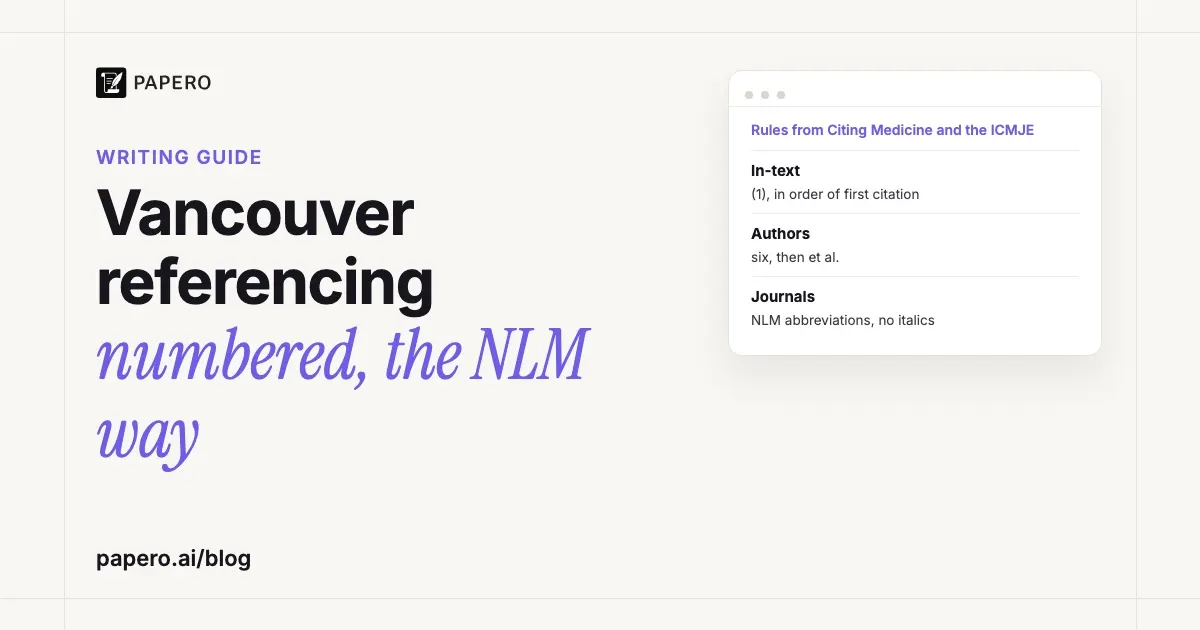
Vancouver referencing is the numbered citation system used in medicine, nursing and the health sciences. Each source gets a number in the order you first cite it, shown in the text as (1), and the reference list runs in that same order. The rules come from the ICMJE Recommendations and the US National Library of Medicine’s Citing Medicine, 2nd edition: surnames with initials, NLM journal abbreviations and no italics.
Key Takeaways
- In-text: the ICMJE asks for Arabic numerals in parentheses, numbered in order of first mention. Some universities use superscript or square brackets instead, so check your course guide.
- A source keeps its first number for the whole paper, and the reference list is numbered, not alphabetical.
- Authors: NLM’s sample references list six, then et al. for seven or more. Citing Medicine itself lists every author and treats a cut to three or six as an option.
- Journal titles are abbreviated as the NLM Catalog shows them and set without italics: N Engl J Med, CMAJ, Diabetes Care.
- Page ranges drop repeated digits (744-52), and an online source adds [Internet], a cited date and “Available from:” with the URL.
Vancouver reference examples by source type
A Vancouver reference gives each author as a surname plus up to two initials, then a title in sentence case, then the publication details, with periods between the parts and no italics. A journal entry packs the date, volume, issue and pages into one string, such as 2007 Mar;30(3):744-52. A book adds the edition, the place, the publisher and the year. The table gives 11 examples across eight common source types.
| Source | Vancouver reference |
|---|---|
| Journal article, up to 6 authors | Jeon CY, Lokken RP, Hu FB, van Dam RM. Physical activity of moderate intensity and risk of type 2 diabetes: a systematic review. Diabetes Care. 2007 Mar;30(3):744-52. |
| Journal article, 7 or more authors | Colberg SR, Sigal RJ, Yardley JE, Riddell MC, Dunstan DW, Dempsey PC, et al. Physical activity/exercise and diabetes: a position statement of the American Diabetes Association. Diabetes Care. 2016 Nov;39(11):2065-79. |
| Organization as author (NLM) | Diabetes Prevention Program Research Group. Hypertension, insulin, and proinsulin in participants with impaired glucose tolerance. Hypertension. 2002;40(5):679-86. |
| Journal article read online | Warburton DE, Nicol CW, Bredin SS. Health benefits of physical activity: the evidence. CMAJ [Internet]. 2006 Mar 14 [cited 2026 Nov 1];174(6):801-9. Available from: https://pmc.ncbi.nlm.nih.gov/articles/PMC1402378/ doi: 10.1503/cmaj.051351 |
| Book (NLM) | Murray PR, Rosenthal KS, Kobayashi GS, Pfaller MA. Medical microbiology. 4th ed. St. Louis: Mosby; 2002. |
| Chapter in an edited book (NLM) | Meltzer PS, Kallioniemi A, Trent JM. Chromosome alterations in human solid tumors. In: Vogelstein B, Kinzler KW, editors. The genetic basis of human cancer. New York: McGraw-Hill; 2002. p. 93-113. |
| Web page | World Health Organization [Internet]. [Geneva]: World Health Organization; c2026. Diabetes; 2024 Nov 14 [cited 2026 Nov 1]. Available from: https://www.who.int/news-room/fact-sheets/detail/diabetes |
| Report (NLM) | Russell ML, Goth-Goldstein R, Apte MG, Fisk WJ. Method for measuring the size distribution of airborne Rhinovirus. Berkeley (CA): Lawrence Berkeley National Laboratory, Environmental Energy Technologies Division; 2002 Jan. Report No.: LBNL49574. Contract No.: DEAC0376SF00098. Sponsored by the Department of Energy. |
| Thesis or dissertation (NLM) | Borkowski MM. Infant sleep and feeding: a telephone survey of Hispanic Americans [dissertation]. Mount Pleasant (MI): Central Michigan University; 2002. |
| Conference paper (NLM) | Leonard KJ, Winkelman W. Developing electronic patient records: employing interactive methods to ensure patient involvement. In: Ferreira de Oliveira MJ, editor. Accessibility and quality of health services. Proceedings of the 28th Meeting of the European Working Group on Operational Research Applied to Health Services (ORAHS); 2002 Jul 28-Aug 2; Rio de Janeiro, Brazil. Frankfurt (Germany): Peter Lang; c2004. p. 241-55. |
| Preprint (NLM) | Alvarez R. Near optimal neural network estimator for spectral x-ray photon counting data with pileup. arXiv:1702.01006v1 [Preprint]. 2017 [cited 2017 Feb 9]: [11 p.]. Available from: https://arxiv.org/abs/1702.01006 |
Rows marked NLM are copied unchanged from the National Library of Medicine’s Samples of Formatted References or from Citing Medicine itself. The other four are ours, built from their PubMed records and the WHO page, checked on 1 November 2026.
Citing Medicine marks the place of publication as required for books, so the city stays in (St. Louis: Mosby), even though APA no longer includes it and MLA and Chicago no longer require it for most books; our guide on how to cite a book shows those three side by side. A chapter starts with its own authors and title, then “In:” and the whole book, and ends with “p.” and the chapter’s pages.
A web page follows Citing Medicine’s pattern for part of a website (the site’s name and publisher first, then the page title, its date and your cited date), minus one element Citing Medicine requires: the length in brackets, such as [about 2 screens], which UWA’s web-page examples also leave out. Add it if your course follows Citing Medicine to the letter. WHO’s fact sheet does not print its city, so the place goes in brackets, as Citing Medicine does for an inferred place. Labels for theses vary: NLM’s sample writes [dissertation], while the University of Sheffield’s guide uses [PhD thesis] and [master’s dissertation]. A preprint carries [Preprint]: the ICMJE says a citation to a preprint should clearly indicate that it is one.
How do you write a Vancouver in-text citation?
Put a number where you use the source. The ICMJE Recommendations ask for references numbered consecutively in order of first mention and identified in the text, tables and legends by Arabic numerals in parentheses. The first source you cite is (1), the next new one is (2), and a source cited again keeps its first number. University guides such as Sheffield’s separate several numbers with commas and join three or more in a row with a hyphen: (1,3,5) or (1-3).
University guides do not all follow the ICMJE’s parentheses. These four, all read on 1 November 2026, show the spread:
| Guide | In-text form | Where the number sits |
|---|---|---|
| ICMJE Recommendations | (1) | Not specified |
| Monash University (Vancouver 2022) | Superscript1 recommended; (1) or [1] also shown | Outside full stops and commas, inside colons and semicolons |
| University of Western Australia | (1) | After full stops and commas, before colons and semicolons |
| University of Sheffield | (1) or superscript1 | Immediately after the material you used |
So “physical activity lowers the risk (1).” and “physical activity lowers the risk.1” are both correct somewhere. When you name authors in your sentence, the number still follows: Jeon et al. (3) found… UWA’s guide uses the first author plus “et al.” for more than two authors, and both authors’ surnames for two. For a direct quotation, the page goes inside the citation: UWA writes (1 p361) and Monash writes 10(p63). IEEE, the numbered style of electrical engineering and computer science, puts the page inside square brackets instead, as in [3, pp. 5–10]; our guide to IEEE citation format covers its other in-text forms.
Under the ICMJE rules, references cited only in a table or figure legend are numbered by where that table or figure is first mentioned in the text, and a personal communication stays out of the numbered list: give the person’s name and the date in parentheses in the text. If you are moving from an author-date style, our guide to APA in-text citations shows the system Vancouver replaces with numbers.
How many authors go in a Vancouver reference?
It depends on which NLM page your guide follows. NLM’s Samples of Formatted References, the page the ICMJE points authors to, says to list the first six authors followed by et al. when there are more than six. Citing Medicine tells you to give all authors, regardless of the number, and shows a cut to the first three or first six as an option. Sheffield and UWA use six; Monash cuts to three.
Citing Medicine’s default lists all nine names of the Colberg article:
Colberg SR, Sigal RJ, Yardley JE, Riddell MC, Dunstan DW, Dempsey PC, Horton ES, Castorino K, Tate DF. Physical activity/exercise and diabetes: a position statement of the American Diabetes Association. Diabetes Care. 2016 Nov;39(11):2065-79.
The NLM samples form stops at six:
Colberg SR, Sigal RJ, Yardley JE, Riddell MC, Dunstan DW, Dempsey PC, et al. Physical activity/exercise and diabetes: a position statement of the American Diabetes Association. Diabetes Care. 2016 Nov;39(11):2065-79.
Monash’s three-author cut applies once a work has more than six. The NLM samples page notes that NLM now lists all authors, as PubMed shows. The University of Western Australia quotes Citing Medicine’s wording that a limit is “not NLM practice” but an acceptable option “if space is a consideration”, and tells students to ask their unit coordinator.
Each name is a surname followed by at most two initials, with no periods and no space between the initials, and a comma and a space between names. Surnames keep the spelling and capitals the article uses, so van Dam RM stays lowercase. An organization goes in as written (Diabetes Prevention Program Research Group), and when a byline has both people and a group, NLM’s sample lists all of them in byline order with a semicolon before the group.
How do you abbreviate journal titles in Vancouver?
Use the abbreviation the NLM Catalog gives for the journal. The ICMJE says journal titles should be abbreviated according to the style used for MEDLINE and points to the NLM Catalog’s list of journals. Citing Medicine adds the mechanics: abbreviate the significant words, leave out articles, conjunctions and prepositions, and capitalize what remains; every NLM example writes the result without periods.
| Journal (as the NLM Catalog records it) | Abbreviation in a Vancouver reference |
|---|---|
| The New England journal of medicine | N Engl J Med |
| Journal of the American College of Surgeons | J Am Coll Surg |
| International journal of nursing studies | Int J Nurs Stud |
| CMAJ : Canadian Medical Association journal = journal de l’Association medicale canadienne | CMAJ |
| Diabetes care | Diabetes Care |
| Lancet | Lancet |
Each abbreviation above was read from the journal’s NLM Catalog record on 1 November 2026. Cite the name the journal had when the article came out: Citing Medicine’s own example is the British Medical Journal, which became BMJ in 1988, so articles from 1987 and earlier are cited as Br Med J. When a journal is not in the NLM Catalog, UWA’s guide suggests the CAS Source Index or building the abbreviation from the ISSN List of Title Word Abbreviations, as Citing Medicine’s Appendix A allows.
Leave out the italics unless your guide asks for them. NLM’s sample references print no italics or bold anywhere, and Citing Medicine warns that too many type styles make a reference harder to read. Monash’s Vancouver 2022 is the exception among the guides we checked: it italicizes the abbreviated journal name, as AMA style does. Our AMA citation style guide sets AMA and NLM Vancouver side by side in a table.
How do you cite online sources, DOIs and PMIDs?
Cite an article you read online as you would the print one, with three additions from Citing Medicine’s chapter on Internet journals: [Internet] after the journal title, the date you cited it in square brackets after the publication date, and “Available from:” followed by the URL. A DOI goes at the end. Citing Medicine also says to cite the version you saw, not the print version if you used the online one.
The Warburton row in the first table shows the full online form. NLM’s samples page also shows a shorter form that MEDLINE uses, with no [Internet] and no URL, just the DOI after the pages, and adds a PubMed PMID as an optional extra:
Warburton DE, Nicol CW, Bredin SS. Health benefits of physical activity: the evidence. CMAJ. 2006 Mar 14;174(6):801-9. doi: 10.1503/cmaj.051351. PubMed PMID: 16534088.
Dates follow one pattern throughout: year, then the month as three letters, then the day, as in 2006 Mar 14. Citing Medicine asks for all three when the journal gives them. NLM’s samples page allows a shorter option for journals with continuous pagination through a volume: drop the month and the issue, as in N Engl J Med. 2002;347:284-7. Some university guides, UWA’s among them, give the year alone.
Page ranges are shortened by dropping the digits that repeat: Citing Medicine’s rule turns 123-125 into 123-5, and 2065-2079 becomes 2065-79. Nothing repeats in 393-403, so it stays as it is.
Vancouver referencing example: a paragraph and its reference list
Here is a short paragraph cited in ICMJE form and the reference list it produces. The sources are numbered in the order the paragraph first uses them, not by author or date, so the World Health Organization page is 1, and it keeps number 1 when the last sentence returns to it.
In 2022, 14% of adults aged 18 and over were living with diabetes, and regular physical activity is one of the ways to prevent or delay type 2 diabetes that the World Health Organization lists (1). A review in CMAJ described the evidence that regular activity helps prevent several chronic diseases, diabetes among them, as irrefutable (2). The effort does not have to be hard: across 10 cohort studies, Jeon et al. (3) found a summary relative risk of type 2 diabetes of 0.69 for regular moderate-intensity activity compared with being sedentary, and a similar result for regular walking. For people who already have diabetes, the American Diabetes Association sets out its own recommendations (4), and the WHO lists physical activity among the ways diabetes can be treated (1).
References
- World Health Organization [Internet]. [Geneva]: World Health Organization; c2026. Diabetes; 2024 Nov 14 [cited 2026 Nov 1]. Available from: https://www.who.int/news-room/fact-sheets/detail/diabetes
- Warburton DE, Nicol CW, Bredin SS. Health benefits of physical activity: the evidence. CMAJ. 2006 Mar 14;174(6):801-9. doi: 10.1503/cmaj.051351.
- Jeon CY, Lokken RP, Hu FB, van Dam RM. Physical activity of moderate intensity and risk of type 2 diabetes: a systematic review. Diabetes Care. 2007 Mar;30(3):744-52. doi: 10.2337/dc06-1842.
- Colberg SR, Sigal RJ, Yardley JE, Riddell MC, Dunstan DW, Dempsey PC, et al. Physical activity/exercise and diabetes: a position statement of the American Diabetes Association. Diabetes Care. 2016 Nov;39(11):2065-79. doi: 10.2337/dc16-1728.
Two of these references show why the record you copy from matters. The Crossref record behind the Warburton DOI lists a single author, “D. E.R.” Warburton, where PubMed lists all three authors with two initials each, the most Citing Medicine allows. PubMed also prints the Colberg title in title case; Vancouver wants sentence case, so “Physical Activity/Exercise and Diabetes” becomes “Physical activity/exercise and diabetes”, with American Diabetes Association kept as a proper noun. The ICMJE asks authors to verify references against a bibliographic source such as PubMed or against the original, and the same check catches references that do not exist at all, a problem our guide to fake AI references covers.
Which version of Vancouver should you follow?
Follow the version your journal or course names, because there is no single Vancouver rulebook. The ICMJE Recommendations, updated January 2026, set the core rules and send authors to NLM’s Samples of Formatted References and to Citing Medicine, 2nd edition. Citing Medicine dates from 2007, and its most recent chapter update is dated August 5, 2020. Universities then write local versions that differ on authors, page ranges, punctuation and in-text form.
Monash’s Vancouver 2022 recommends superscript numbers, borrows AMA’s three-author cut, italics and full page ranges (123-129), and drops [Internet]. Our Vancouver style glossary entry gives the short version of the system. When your instructions are silent, use the ICMJE form: numbers in parentheses, six authors then et al., NLM abbreviations, and the same choices throughout.
Where Papero fits
Papero is an AI writing workspace for students and researchers. It finds real papers to cite for the sentence you are writing, looks sources up by DOI, PMID, arXiv ID or ISBN, and formats the in-text citations and the reference list in Vancouver or one of eight other styles: APA 7, MLA 9, Chicago author-date, Harvard, IEEE, AMA 11, Nature and ACS.
Papero’s Vancouver option formats with the Citation Style Language’s NLM/Vancouver style file, which is based on Citing Medicine: in-text numbers in parentheses, references in order of first citation, six authors then et al. for seven or more, and shortened page ranges. On the free plan, in-text citations work in full and the reference list shows your entries blurred; Plus makes it readable, copyable and exportable. For a few references without an account, the free PMID to citation generator takes up to 10 PubMed IDs at a time and 30 a day and offers Vancouver. Check what it returns against the rules above, as you would references formatted in the editor, which uses the same style file: the tool’s own worked example prints the journal name in full and the title with capitals, and it says plainly that journal names are sometimes given in full where your style wants the abbreviation. The research paper writing page shows the whole workflow, from an IMRaD outline to a Word manuscript.
Frequently Asked Questions
Is Vancouver the same as NLM style?
In practice, yes. The ICMJE, once known as the Vancouver Group, first published its manuscript requirements in 1978, and its current Recommendations tell authors to follow NLM’s Samples of Formatted References and its style guide Citing Medicine. The two NLM sources differ on one visible point: the samples list six authors before et al., while Citing Medicine lists all authors by default.
Does Vancouver use et al.?
Yes, in two places. In the reference list, NLM’s sample references list the first six authors and then et al. when a work has seven or more; some university guides cut to three. In the text, a work with three or more authors is named by the first author’s surname plus et al., followed by its number, as in Jeon et al. (3).
Do you italicize anything in a Vancouver reference?
Not in the NLM version. NLM’s sample references use no italics for journal titles, book titles or anything else. Journal titles are abbreviated in plain text, such as N Engl J Med. A few university versions, such as Monash’s Vancouver 2022, italicize the journal name, so follow your guide.
Is a Vancouver reference list alphabetical?
No. A Vancouver reference list is numbered in the order the sources are first cited in the text. The first source you cite is number 1 in the list, wherever its author falls in the alphabet, and a source cited several times appears only once, under its first number.
How do you cite a website in Vancouver?
Give the name of the website with [Internet], then the place and publisher, the copyright year, the title of the page, its date, the date you cited it in square brackets, and “Available from:” with the URL. For example: World Health Organization [Internet]. [Geneva]: World Health Organization; c2026. Diabetes; 2024 Nov 14 [cited 2026 Nov 1]. Available from: the page’s URL.
Does the Vancouver number go before or after the full stop?
It depends on your guide. The ICMJE asks for numbers in parentheses but does not fix their position. The University of Western Australia puts the number after full stops and commas and before colons and semicolons; Monash places superscript numbers outside full stops and commas. Use one placement throughout.
Sources
- National Library of Medicine, Citing Medicine: The NLM Style Guide for Authors, Editors, and Publishers, 2nd edition (Patrias K, Wendling D, 2007; chapters 1 Journals and 23 Journals on the Internet updated May 18, 2018, 2 Books and 25 Web Sites updated August 11, 2015, 3 Conference Publications updated August 5, 2020, 14 Manuscripts and Preprints updated March 17, 2017; read through Internet Archive copies, November 2026): https://www.ncbi.nlm.nih.gov/books/NBK7256/
- National Library of Medicine, “Samples of Formatted References for Authors of Journal Articles” (nlm.nih.gov, last reviewed June 2, 2026): https://www.nlm.nih.gov/bsd/uniform_requirements.html
- International Committee of Medical Journal Editors, “Preparing a Manuscript for Submission to a Medical Journal”, section g. References (Recommendations updated January 2026): https://www.icmje.org/recommendations/browse/manuscript-preparation/preparing-for-submission.html
- International Committee of Medical Journal Editors, “History of the Recommendations” (icmje.org, accessed November 2026): https://www.icmje.org/recommendations/browse/about-the-recommendations/history-of-the-recommendations.html
- International Committee of Medical Journal Editors, “ICMJE Membership” FAQ (icmje.org, accessed November 2026): https://www.icmje.org/about-icmje/faqs/icmje-membership/
- National Library of Medicine, NLM Catalog: Journals referenced in the NCBI Databases (accessed November 2026): https://www.ncbi.nlm.nih.gov/nlmcatalog/journals
- Monash University Library, “In-text citation” and “Articles”, Vancouver 2022 (guides.lib.monash.edu, last updated August 28, 2026): https://guides.lib.monash.edu/vancouver-2022/in-text-citation
- University of Western Australia Library, “Referencing style: Vancouver (based on Citing Medicine)”, Introduction, Journal article, Web page and Quotes and page numbers (guides.library.uwa.edu.au, last updated October 15, 2026): https://guides.library.uwa.edu.au/vancouver
- University of Sheffield Library, “Vancouver referencing” (librarydevelopment.group.shef.ac.uk, accessed November 2026): https://librarydevelopment.group.shef.ac.uk/referencing/vancouver.html
- World Health Organization, “Diabetes” fact sheet (who.int, November 14, 2024): https://www.who.int/news-room/fact-sheets/detail/diabetes
- Warburton DE, Nicol CW, Bredin SS. Health benefits of physical activity: the evidence. CMAJ. 2006 Mar 14;174(6):801-9. https://doi.org/10.1503/cmaj.051351
- Jeon CY, Lokken RP, Hu FB, van Dam RM. Physical activity of moderate intensity and risk of type 2 diabetes: a systematic review. Diabetes Care. 2007 Mar;30(3):744-52. https://doi.org/10.2337/dc06-1842
- Colberg SR, Sigal RJ, Yardley JE, Riddell MC, Dunstan DW, Dempsey PC, et al. Physical activity/exercise and diabetes: a position statement of the American Diabetes Association. Diabetes Care. 2016 Nov;39(11):2065-79. https://doi.org/10.2337/dc16-1728
- Crossref REST API record for DOI 10.1503/cmaj.051351 (api.crossref.org, accessed November 1, 2026): https://api.crossref.org/works/10.1503/cmaj.051351