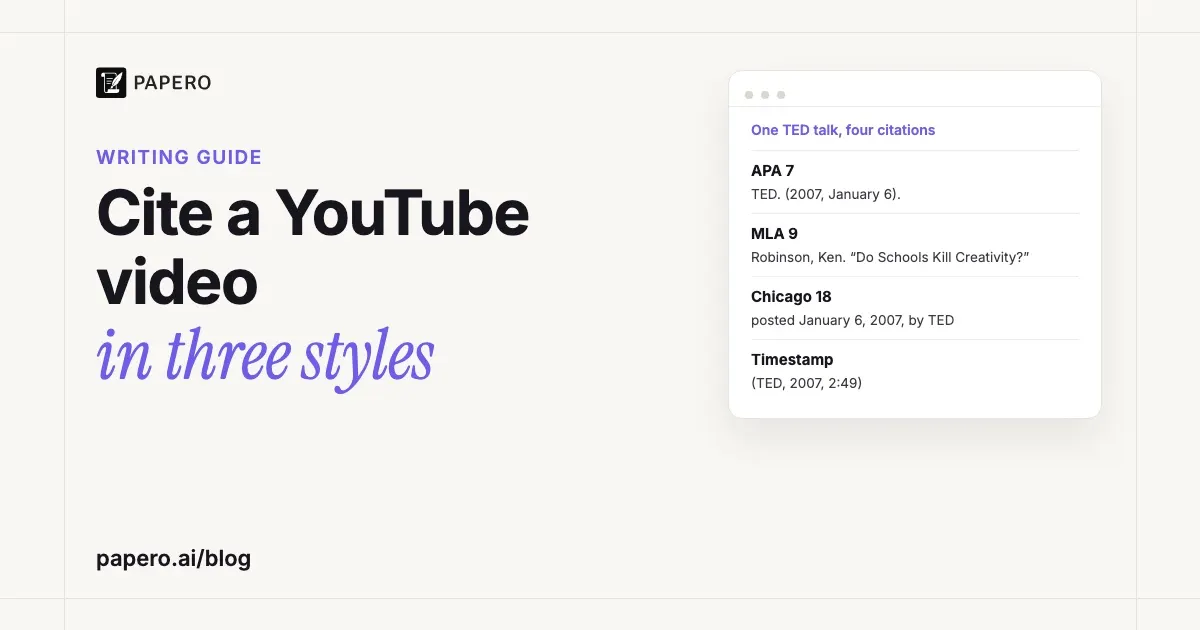
To cite a YouTube video, record who uploaded it, the upload date, the title exactly as YouTube shows it, and the URL. In APA 7 the uploading channel is the author: TED. (2007, January 6). Do schools kill creativity? | Sir Ken Robinson | TED [Video]. YouTube. https://www.youtube.com/watch?v=iG9CE55wbtY. In the text: (TED, 2007), plus a timestamp such as 2:49 for a quotation. MLA and Chicago name the speaker first instead.
Key Takeaways
- APA 7 makes the account that uploaded the video the author, even when someone else speaks, and puts [Video] after the italic title.
- MLA 9 names the creator when that person is clear, puts the title in quotation marks with YouTube as the container, and adds the channel after “uploaded by” when the creator is unclear or when it helps.
- Chicago 18 also names the speaker but uses the talk’s own title, then “posted [date], by [channel]”, YouTube and the running time.
- A quotation needs a time: the start time in APA (TED, 2007, 2:49), a range in MLA (00:02:49–58) and in Chicago (at 2:49–58).
- A YouTube Short is cited like any other video; no style has a separate Shorts rule.
How to cite a YouTube video: APA, MLA and Chicago examples
The table cites one real video four ways: Sir Ken Robinson’s 2006 TED talk, uploaded by the TED channel on January 6, 2007, and running 20:03. The speaker and the uploader differ, the case that trips people up. The upload details come from the video’s YouTube page, read on November 1, 2026.
| Style | Reference or bibliography entry | In-text citation or note |
|---|---|---|
| APA 7 | TED. (2007, January 6). Do schools kill creativity? | Sir Ken Robinson | TED [Video]. YouTube. https://www.youtube.com/watch?v=iG9CE55wbtY | (TED, 2007, 2:49) for a quotation, or (TED, 2007) |
| MLA 9 | Robinson, Ken. “Do Schools Kill Creativity? | Sir Ken Robinson | TED.” YouTube, uploaded by TED, 6 Jan. 2007, www.youtube.com/watch?v=iG9CE55wbtY. | (Robinson 00:02:49–58) |
| Chicago 18, notes-bibliography | Robinson, Ken. “Do Schools Kill Creativity?” TED Talk, February 25, 2006. Posted January 6, 2007, by TED. YouTube, 20:03. https://www.youtube.com/watch?v=iG9CE55wbtY. | 1. Ken Robinson, “Do Schools Kill Creativity?,” TED Talk, February 25, 2006, posted January 6, 2007, by TED, YouTube, 20:03, https://www.youtube.com/watch?v=iG9CE55wbtY. |
| Chicago 18, author-date | Robinson, Ken. 2006. “Do Schools Kill Creativity?” TED Talk, February 25. Posted January 6, 2007, by TED. YouTube, 20:03. https://www.youtube.com/watch?v=iG9CE55wbtY. | (Robinson 2006, at 2:49–58) |
The times point to this sentence from the talk: “My contention is that creativity now is as important in education as literacy, and we should treat it with the same status.” TED’s own transcript, which TED’s site plays against this same YouTube upload, starts that sentence at 2:49 and has the audience applauding at 2:58.
How do you cite a YouTube video in APA?
In APA 7, start with the name of the account that uploaded the video, then the exact upload date in parentheses, the video’s title in italics, [Video] in square brackets, YouTube and the URL. The in-text citation uses the channel and the year: (TED, 2007). When quoting, add the time the quotation starts, as in (TED, 2007, 2:49).
The rules come from APA’s “YouTube video references” page, which covers the Publication Manual (7th ed.), section 10.12. It says to “use the name of the account that uploaded the video as the author” and to “provide the specific date on which the video was uploaded.” APA’s TED Talk page gives the reason for a TED talk on YouTube: list the account owner “to aid in retrieval.”
The speaker goes into your sentence. APA’s TED page models it with Janelle Shane’s talk, and the same pattern for Robinson reads:
Robinson argued that “creativity now is as important in education as literacy” (TED, 2007, 2:49).
The time stamp replaces a page number. APA’s page on quotations without page numbers says to give “a time stamp for the beginning of the quotation” for audiovisual works, naming YouTube videos and TED Talks. A paraphrase needs no time, though one helps a reader find a long video’s point. Write the title in sentence case, which for this upload changes nothing. In your reference list the entry goes in alphabetical order under T; our guide to the APA reference page covers the ordering rules.
If the uploading account is not the creator, APA asks you to explain that in your text when it matters. When the uploader looks unreliable, APA suggests checking the creator’s own channel or website for the same video and citing that copy.
How do you cite a YouTube video in MLA?
In MLA 9, name the creator as author when it is clear who made the video, then the title in quotation marks, YouTube in italics as the container, “uploaded by” and the channel name when it adds something (always when the creator is unclear), the upload date in day-month-year order and the URL without https://. In the text, cite the creator’s surname and the time range you quote: (Robinson 00:02:49–58).
That order comes from the MLA Style Center’s “How do I cite YouTube videos?” (March 30, 2022, written for the ninth edition). It says the title of the video “is copied exactly as it appears on YouTube,” which is why the “| Sir Ken Robinson | TED” stays. We capitalized it in title case, as MLA’s own examples do: its eighth-edition entry for a knitting video prints “(SSK)” where the YouTube page shows “(ssk)”. MLA adds that you “might opt to include” the uploader even when the creator is known, if it helps. Here it does, because it tells readers the talk is TED’s official upload.
Italics still apply to a self-contained work posted on YouTube, such as a full film: MLA’s example is Moby Dick, directed by John Huston, followed by YouTube as a second container. For a film or an image that is not on YouTube, our guides on how to cite a movie and how to cite an image each cite one real work four ways, in APA, MLA and both Chicago systems. For a song you streamed rather than watched, our guide on how to cite a song cites one recording in MLA, APA and Chicago, with timestamps.
For the time stamp, the MLA Handbook (9th ed., p. 250, as quoted by Douglas College Library) says to “give the numbers of the hours, minutes, and seconds as displayed in your media player, separating the numbers with colons.” Its own example is (“Buffy” 00:03:16–17). With Robinson named in your sentence, the parentheses hold only the time: Robinson says creativity deserves “the same status” as literacy (00:02:49–58). Our MLA in-text citation guide covers the other locators MLA uses, and the entry goes on your works cited page in alphabetical order.
How do you cite a YouTube video in Chicago?
In Chicago 18, a note names the speaker, the title of the talk or lecture in quotation marks, what it is and when it happened, then “posted [date], by [channel]”, YouTube, the running time and the URL. A shortened note adds the time you quote: Robinson, “Do Schools Kill Creativity?,” at 2:49–58. The author-date form puts the year of the event after the name.
The model is the video entry in Chicago’s citation quick guide for the 18th edition (CMOS 14.167). Its note reads: Eric Oliver, “Why So Many Americans Believe in So Many ‘Crazy’ Things,” moderated by Andrew McCall, virtual lecture, February 23, 2022, posted March 21, 2022, by University of Chicago, YouTube, 1:01:45, followed by the youtu.be link. Its TED example, a talk watched on ted.com, shortens to Cowan, “Green Hydrogen,” at 6:09–17.
For Robinson, the event date is February 25, 2006, the recording date on TED’s own page for the talk, so the author-date entry puts 2006 after the name although the upload is from 2007.
Chicago says “video” or the like may be added unless it is clear from context; its Oliver entry, with YouTube and a running time, does without it. Our guide to Chicago footnotes explains how full and shortened notes work together.
Who is the author: the channel or the person in the video?
The three styles split on this. APA makes the uploading channel the author and names the speaker in your sentence. MLA names the creator when that is clear and moves the channel to “uploaded by”. Chicago names the speaker and credits the channel with “posted [date], by [channel]”.
| Situation | APA 7 | MLA 9 | Chicago 18 |
|---|---|---|---|
| Speaker differs from uploader (a TED talk on TED’s channel) | Channel as author; speaker named in your sentence | Speaker as author; channel after “uploaded by” | Speaker as author; “posted [date], by” channel |
| Creator uses a channel name | Real name, then the channel name in square brackets | Real name as author; channel name exactly as written | Real name as author; channel after “posted [date], by” |
| Creator unknown | Channel as author | Start with the title; channel after “uploaded by” | Not shown in Chicago’s quick guide |
The MLA Style Center’s interview example shows why the channel name must be exact: the uploader is “Jimmy Kimmel Live,” which “differs slightly from the name of the television show Jimmy Kimmel Live!” For interviews heard on the radio, read in print or conducted by you, see our guide to citing an interview.
How do you cite a YouTube channel name instead of a real name?
When you know the person behind a channel, APA puts the real name first and the channel name in square brackets after it. Michael Stevens presents Vsauce, so his video becomes Stevens, M. [Vsauce]. (2019, October 24). What is the scariest thing? [Video]. YouTube. https://www.youtube.com/watch?v=9Vmwsg8Eabo, cited in the text as (Stevens, 2019).
That wording, “provide the real name of the individual or group, followed by the username in square brackets,” is APA’s rule for social media authors, as Swansea University’s APA 7 guide states it on its YouTube page. APA’s current YouTube page does not show this form; its pages for X and TikTok do, with the @handle in the brackets. If you only know the channel name, use it alone, with no brackets.
In MLA, the same video is Stevens, Michael. “What Is the Scariest Thing?” YouTube, uploaded by Vsauce, 24 Oct. 2019, www.youtube.com/watch?v=9Vmwsg8Eabo. Take the real name from the video’s own page (here, its tags name Michael Stevens), never from a fan wiki.
How do you cite a YouTube Short?
Cite a Short like any other YouTube video: same author rules, same [Video] label in APA, and the URL from your address bar, which for a Short contains /shorts/. Quotations take a time the same way, even in a video a minute long.
None of the three styles’ guidance mentions Shorts. The MLA’s own channel posts Shorts, such as “How to Cite a Movie with MLA Style,” uploaded on April 13, 2026, by the account ModernLanguageAssoc, 1:05 long.
- APA 7: Modern Language Association [ModernLanguageAssoc]. (2026, April 13). How to cite a movie with MLA style [Video]. YouTube.
https://www.youtube.com/shorts/MYUcRznFufU - MLA 9: Modern Language Association. “How to Cite a Movie with MLA Style.” YouTube, uploaded by ModernLanguageAssoc, 13 Apr. 2026,
www.youtube.com/shorts/MYUcRznFufU.
The APA entry uses the group form of the bracket rule. For MLA, the creator is clear, so the entry starts with it; “uploaded by” keeps the account name exactly as YouTube prints it. The in-text citation is (Modern Language Association).
What if the video has no date, or you watched it on another site?
Every YouTube video page shows an upload date, so a missing date usually means you met the video somewhere else: embedded in a website, a news story or a course page. If you can open the YouTube original, cite that. If not, cite the page you used, write (n.d.) in APA, and in MLA leave the date out and add “Accessed” with the day you watched.
APA’s missing-information page gives the no-date pattern: Author. (n.d.). Title. Source. MLA treats an access date as optional, but its Style Center calls it “especially useful if the work lacks a publication date,” and Purdue OWL’s MLA 9 pages say the same. A YouTube channel page, as opposed to a video, gets (n.d.) and a retrieval date in APA, because the page keeps changing: APA’s example is APA Publishing Training. (n.d.). Home [YouTube channel]. YouTube.
APA lets a student cite a video from a learning management system such as Canvas or Moodle with the system’s name and its login page URL, because the instructor and classmates can open it; for readers outside the course, it becomes a personal communication. APA’s course-pack page settles embedded videos: material reproduced unchanged from a widely available source is cited from that source. So a YouTube video embedded in your course page is cited from YouTube.
In MLA, if you cite the video as you watched it on another site, that site is the container (eighth-edition advice), and when the page could hold other things with the same title, MLA adds “Video” at the end of the entry, as in its example from beyonce.com.
Where Papero fits
Papero is an AI writing workspace for students and researchers. Its citations come from scholarly records: papers found through OpenAlex, lookups by DOI, PMID, arXiv ID or ISBN, and manual entries. The manual entry types are journal articles, books, book chapters, web pages and reports. There is no video type, so you write a YouTube entry yourself, using the patterns above.
The Papero Web Importer for Chrome saves any page that is not a paper as a webpage source, and a YouTube page would be formatted as a web page, without the [Video] label or the uploader rules. If you save one that way, rewrite its entry before you hand the paper in. Papero formats nine styles, including APA 7, MLA 9 and Chicago author-date; it does not produce Chicago footnotes, so write video notes by hand. The essay writing page shows how citing works while you draft.
Frequently Asked Questions
Do you need a timestamp when citing a YouTube video?
You need one for a direct quotation in APA, where the time the quotation starts replaces the page number, as in (TED, 2007, 2:49). MLA asks for the time or time span of the part you cite, written as hours, minutes and seconds, such as 00:02:49–58. Chicago adds the time to a note or author-date citation with “at”. In APA, a paraphrase needs no time, though one helps readers find the point.
Who is the author of a YouTube video in APA?
The author is the account that uploaded the video. For a TED talk on YouTube, that is TED, not the speaker: TED. (2007, January 6). APA says to name the speaker in your sentence instead. If you know the real name behind a channel name, write the real name first and the channel name in square brackets, as in Stevens, M. [Vsauce].
Is the title of a YouTube video italicized?
APA italicizes the title of the video and adds [Video] after it in plain type. MLA 9 puts the title in quotation marks and italicizes YouTube, the container, though a full film or other self-contained work uploaded to YouTube keeps its italics. Chicago 18 puts the title of a talk or lecture in quotation marks.
How do you cite a YouTube livestream?
If the livestream was archived and can still be watched, cite the recording like any other YouTube video, with its upload date. APA says a livestream that was not archived and cannot be found anywhere else is cited as a personal communication. Personal communications are cited in the text only, with no reference list entry, because readers cannot retrieve them.
Do you include the full YouTube URL in a citation?
Yes. APA ends the reference with the full URL, including https://. MLA gives the URL without https://, and Chicago ends the note or bibliography entry with it. Copy the URL from the video’s own page rather than from a search results page, so the link opens the video you cited.
Sources
- American Psychological Association, “YouTube video references” (apastyle.apa.org, date created 2020, read November 2026 through the Internet Archive, capture of October 8, 2026): https://apastyle.apa.org/style-grammar-guidelines/references/examples/youtube-references
- American Psychological Association, “TED Talk references” (apastyle.apa.org, last updated January 2022, read November 2026 through the Internet Archive): https://apastyle.apa.org/style-grammar-guidelines/references/examples/ted-talk-references
- American Psychological Association, “Quotations from material without page numbers” (apastyle.apa.org, read November 2026 through the Internet Archive, capture of September 30, 2026): https://apastyle.apa.org/style-grammar-guidelines/citations/quotations/no-page-numbers
- American Psychological Association, “Missing reference information” (apastyle.apa.org, read November 2026 through the Internet Archive): https://apastyle.apa.org/style-grammar-guidelines/references/missing-information
- American Psychological Association, “Classroom or intranet sources” and “Classroom course pack material references” (apastyle.apa.org, read November 2026 through the Internet Archive): https://apastyle.apa.org/style-grammar-guidelines/citations/classroom-intranet-sources, https://apastyle.apa.org/style-grammar-guidelines/references/examples/classroom-course-references
- American Psychological Association, “X references” and “TikTok references” (apastyle.apa.org, last updated June 2024, read November 2026 through the Internet Archive): https://apastyle.apa.org/style-grammar-guidelines/references/examples/x-references, https://apastyle.apa.org/style-grammar-guidelines/references/examples/tiktok-references
- Swansea University Library, “APA referencing: YouTube/online videos” (libguides.swansea.ac.uk, last updated August 19, 2026): https://libguides.swansea.ac.uk/APA7Referencing/YouTube
- MLA Style Center, “How do I cite YouTube videos?” (style.mla.org, March 30, 2022): https://style.mla.org/citing-youtube-videos/
- MLA Style Center, “How do I cite an online video?” (style.mla.org, September 28, 2017, eighth-edition guidance): https://style.mla.org/citing-an-online-video/
- MLA Style Center, “How do I cite an interview found on YouTube?” (style.mla.org, May 26, 2020): https://style.mla.org/an-interview-found-on-youtube/
- MLA Style Center, “When should I include an access date for an online work?” (style.mla.org, December 29, 2016, eighth-edition guidance): https://style.mla.org/access-dates/
- MLA Style Center, “MLA Style Videos” (style.mla.org, accessed November 2026): https://style.mla.org/mla-style-videos/
- Douglas College Library, “MLA 9th Edition: Audiovisual” and “In-Text Citations”, quoting the MLA Handbook, 9th ed., p. 250 (guides.douglascollege.ca, last updated October 28, 2026): https://guides.douglascollege.ca/MLA-9/Audiovisual, https://guides.douglascollege.ca/MLA-9/InTextCitations
- Purdue OWL, “MLA Works Cited: Electronic Sources” (owl.purdue.edu, accessed November 2026): https://owl.purdue.edu/owl/research_and_citation/mla_style/mla_formatting_and_style_guide/mla_works_cited_electronic_sources.html
- The Chicago Manual of Style Online, “Notes and Bibliography: Sample Citations” and “Author-Date: Sample Citations”, 18th edition, Video or podcast (chicagomanualofstyle.org, read November 2026 through the Internet Archive, capture of October 23, 2026): https://www.chicagomanualofstyle.org/tools_citationguide/citation-guide-1.html, https://www.chicagomanualofstyle.org/tools_citationguide/citation-guide-2.html
- The Chicago Manual of Style, 18th edition, chapter 14 contents (section 14.167, “Online videos”): https://www.chicagomanualofstyle.org/book/ed18/part3/ch14/toc.html
- TED, “Do schools kill creativity? | Sir Ken Robinson | TED” (YouTube, uploaded January 6, 2007, 20:03, opened November 1, 2026):
https://www.youtube.com/watch?v=iG9CE55wbtY - TED, “Do schools kill creativity?” transcript, Sir Ken Robinson, TED2006, recorded February 25, 2006 (ted.com, read November 1, 2026): https://www.ted.com/talks/sir_ken_robinson_do_schools_kill_creativity/transcript
- Vsauce, “What Is The Scariest Thing?” (YouTube, uploaded October 24, 2019, opened November 1, 2026):
https://www.youtube.com/watch?v=9Vmwsg8Eabo - ModernLanguageAssoc, “How to Cite a Movie with MLA Style” (YouTube Short, uploaded April 13, 2026, opened November 1, 2026):
https://www.youtube.com/shorts/MYUcRznFufU