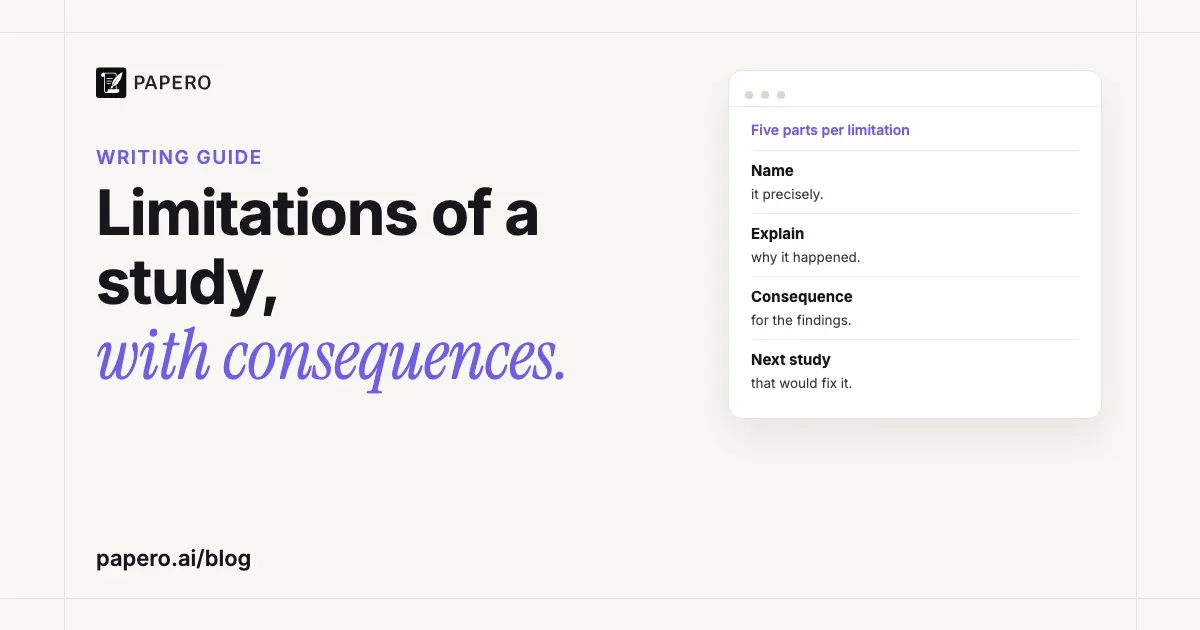
The limitations of a study are the weaknesses in its design, data or circumstances that limit how far its findings can be trusted or applied. Writing one well takes five parts: name the limitation, explain why it exists, say what it does to the findings, say what you did about it, and name the study that would fix it. Below are the main types, with example sentences, and limitations from three published papers, annotated.
Key Takeaways
- Every study has limitations. Admitting them yourself tells readers how far to trust the result.
- A limitation without a consequence is half written: say whether it pushes the result up or down, narrows who it applies to, or rules out a causal claim.
- Report the limitations that matter for your conclusions, not generic ones. In one survey of biomedical papers, those that reported any gave a median of three.
- In an article, limitations go in the discussion, often in their own subsection. A thesis also announces them in Chapter 1 or the methodology.
What are the limitations of a study?
Limitations are the constraints on what a study can show: who the findings apply to, how accurately things were measured, and whether a cause can be claimed. They come from the design you chose, from the data you could get, and from problems that appeared during the research. Reporting them tells readers how much weight the findings can carry.
Many published papers report them badly. Ioannidis (2007) read 400 articles from eight leading journals and found that only 67 (17%) used at least one word denoting limitations of the work presented, and only five had a separate section on limitations. A survey of 300 biomedical papers by ter Riet and colleagues (2013) found that 27% mentioned none. Puhan and colleagues (2012) give the reason to do better: when important limitations are missing, readers and reviewers “may perceive that the authors were unaware of them.”
What are the main types of limitations?
Most limitations fall into seven groups: who took part, how things were measured, what the design can show about cause, who the results apply to, what data went missing, the researcher’s influence in qualitative work, and time and resources. Each example sentence below is ours, invented to show the pattern, and each states a consequence.
| Type | Example sentence (ours) |
|---|---|
| Sample and selection (volunteers, one site, low response) | Students volunteered, so those already interested in sleep are probably over-represented and the average sleep time we report is likely higher than in the whole year group. |
| Measurement (self-report, single items, unvalidated scales) | Study hours were self-reported once at the end of term, so they are imprecise, which is more likely to have weakened the link we found than to have created it. |
| Design and causal inference (observational data, confounders) | Sleep and grades were measured at the same time, so we cannot tell whether poor sleep lowers grades or exam stress disturbs sleep. |
| Generalisability (one country, setting or period) | All participants studied at one university during remote teaching, so the pattern could differ where teaching was in person. |
| Missing data and attrition | A third of participants missed the follow-up and those who left had lower starting scores, so the improvement we report is probably overstated. |
| Qualitative: transferability and the researcher’s position | I interviewed students I had taught, so some could have held back criticism of the module; interviews took place after grades were released to reduce this. |
| Time, access and resources | The project ran for one semester, so we followed students for eight weeks and cannot say whether the effect lasted. |
The sample row turns on how participants were chosen: the glossary entry on random sampling explains why a convenience sample cannot be generalised the way a random one can. The design row is about confounders and control variables: a third variable linked to both predictor and outcome is the usual reason an observational study cannot claim cause. How to spot and control a confounding variable, and how to name one in a limitations paragraph, has a guide of its own. So does the sample row: our guide to convenience samples shows how to state which group is over-represented and which way that pushes a result.
Qualitative limitations use their own vocabulary. APA’s qualitative reporting standard, JARS-Qual, asks authors to “Describe the limits of the scope of transferability”, and George Washington University’s (GWU) dissertation guide asks: “How did the researcher’s presence perhaps affect the phenomena being studied?” Our comparison of qualitative vs quantitative research explains the quality criteria behind those words.
How do you write the limitations of a study?
Write each limitation in five parts: name it precisely, explain why it happened, state its consequence for the findings, say what you did to reduce it or how to read the result, and point to the study that would remove it. The parts come from Ross and Bibler Zaidi’s guide, USC’s checklist and the STROBE reporting guideline.
- Name it precisely. “The sample was small” names nothing; “64 volunteers from one statistics course” lets the reader judge.
- Explain why it exists. USC asks you to “Explain why each limitation exists” and why it “could not be overcome using the method(s) chosen”.
- State the consequence. STROBE asks authors to “Discuss both direction and magnitude of any potential bias”: does it make the result look bigger, smaller, or apply to fewer people?
- Say what you did about it. Ross and Bibler Zaidi ask authors to “describe steps taken to mitigate the limitation”, and Puhan and colleagues to discuss strengths that “counterbalance or outweigh (some of) the limitations.”
- Point to the next study. Name the design that would close the gap, not “more research is needed”.
Part 3 in one real sentence, from Barbosa and colleagues’ (2024) survey of 8,650 Brazilian university students: “Physical activity, for example, was assessed only in the leisure domain, which may lead to an underestimation of the total time spent practicing physical activity.” The reader knows which way the error runs.
The same idea as a before and after, both ours:
Before: “This study has some limitations. The sample size was small and the data were self-reported. Future research should use a larger sample.”
After: “Our 64 participants volunteered from one statistics course, so students who already cared about study habits are probably over-represented, and the average study time we report is likely higher than in the course as a whole. Study time came from a weekly diary; errors of this kind tend to be similar across students, so they would usually weaken the link with exam scores rather than create it. We therefore read the correlation as an association among motivated students, which a study logging study time automatically across several courses could test.”
The added sentences say which way each weakness pushes the result and how much of the claim survives. Limitations also feed the next project: other papers’ limitations are a quick source of open questions when you choose a research topic.
Limitations of the study examples from published papers
The two passages below come from a quantitative survey and a qualitative focus-group study, both open access under a Creative Commons Attribution (CC BY 4.0) licence, as is the Barbosa paper quoted above. They are quoted exactly and annotated against the five parts, so you can see which parts each one covers and which it skips.
Example 1: a quantitative survey
Yeo and colleagues (2024), in BMC Public Health, analysed health-screening questionnaires from 15,630 students entering a university in Singapore during the COVID-19 pandemic. Their limitations subsection, at the end of the discussion, opens: “This study has some limitations that warrant caution in interpreting the findings.” The second of five:
Second, we employed a cross-sectional study design that captured the data at one point in time during the pandemic, which precluded us from comparing the depression rates and risk factors before and after the pandemic. A longitudinal design following the same cohort would have been ideal to examine the temporal changes in depression outcomes, but it was not feasible given the logistical challenges of conducting such a study with this population during a global health crisis. Therefore, we opted for a cross-sectional design that enabled us to collect data from a sizable and diverse sample of university entrants to estimate the prevalence of depression. However, this also means that our analysis can only infer associations and not causality.
Four of the five parts in four sentences: the design and what it prevented, the better design and why it was not used, the trade-off (a large sample for estimating prevalence, the study’s aim), and the consequence for every finding in the paper. What it skips is part 5: the longitudinal design appears as what would have been ideal, not as the next study to run. Our guide to cross-sectional study design walks through the limitations a national survey of 20,103 high school students reported about itself.
Their third limitation, a single university, would be the kind of generic label Ross and Bibler Zaidi warn against, except that it names who the findings may not reach (other age groups, countries with different pandemic measures) and the next study: recruiting “from multiple universities and different age groups”.
Example 2: a qualitative focus-group study
Guthardt and colleagues (2024), in BMC Medical Education, ran seven focus groups with 57 dental students in Germany about stress. Their “Strengths and limitations” subsection comes just before the implications. The first limitation concerns who was in the room:
The proportion of men in our study was slightly lower than expected: Only nine male students took part in the focus groups. Therefore, we cannot rule out that views held by male students were explored less thoroughly than those of female students (i.e., 16% male participants). This may present a particular issue if the perceptions of stressors, resources and possible interventions differ by gender, so that further studies including more male students might be useful.
The consequence is worded for qualitative research: no claim about representativeness, only that some views may have been “explored less thoroughly”, then when that would matter and the next study. A later limitation shows part 4. Participants knew each other, “which could be a limitation of our study. However, this might have been a benefit as well because there was a trusting atmosphere.” The authors then list what they did about it: participants were addressed by numbers on the recording, and the groups met outside the dental faculty with no dental staff present.
What is the difference between limitations and delimitations?
Delimitations are the boundaries you set on purpose to keep a study manageable: the population, the setting, the time span, the variables left out. Limitations are the weaknesses that affect what your findings can show, many outside your control. A delimitation needs a reason; a limitation needs a consequence. One choice can produce both: surveying only first-year students is a delimitation, and not knowing whether the result holds in later years is its limitation.
| Limitation | Delimitation | |
|---|---|---|
| Where it comes from | The design, the data or events during the study | A choice made while planning |
| Question it answers | What weakens or narrows these findings? | Where did I draw the boundaries, and why? |
| Example (ours) | 40% of invited students did not respond | Only first-year students were invited |
| What you write | Its consequence for the findings | The reason for the boundary |
| Usual place | Discussion (a thesis also in Chapter 1) | Thesis Chapter 1, the proposal or the methods |
Theofanidis and Fountouki (2018) call delimitations “in essence the limitations consciously set by the authors themselves”, and say limitations are “usually out of the researcher’s control”. Other sources draw the line differently: Ross and Bibler Zaidi count conscious design choices as one origin of limitations, and GWU’s guide says “Some limitations arise from the delimitations of the study”. In practice, give the boundary and its reason where you describe the study, and its cost in the discussion.
Where do limitations go in a research paper or thesis?
In a journal article or course paper, limitations go in the discussion, usually as a paragraph or a subsection headed “Limitations” or “Strengths and limitations”. Place them near the start of the discussion, so readers weigh the findings with them in mind, or near the end, leading into future research, but not buried in the middle. A thesis also announces them early, in Chapter 1 or the methodology chapter.
USC’s guide warns that limitations “should not be buried in the body [middle] of the discussion section”, and both examples above put them near the end. For the full order of a discussion, see our guide on how to write a discussion section. Puhan and colleagues also suggest one abstract sentence on “the one or two main limitations of the study”.
A thesis splits the job. GWU’s dissertation guide puts “Limitations and Delimitations” in Chapter 1, telling students to “forewarn readers of the limitations and the reasons for them”, and has Chapter 5 interpret the results in light of “the limitations of the study and literature.” Many departments also expect the methodology chapter to state the limits of the method, as our guide on how to write a methodology section shows, and a proposal names its research design with the limitations it expects. The limitations section of our sample research proposal shows what that looks like before any data exist. In a finished study, USC adds, limitations “should be stated in the past tense”. Your handbook overrides all of this.
How many limitations should you include, and how long?
Include the limitations that could change how a reader interprets your main findings, usually two to four, and leave out generic ones that apply to almost any study. In a journal article or course paper this takes one to three paragraphs. A thesis discussion chapter gives them more room, with the consequence and the next study spelled out for each.
In ter Riet and colleagues’ survey, papers that acknowledged limitations gave a median of three (range one to eight), and James Madison University’s writing center advises “1-3 paragraphs; often, this appears as a “Limitations” subsection”. The guidance pulls two ways, though. Puhan and colleagues ask authors to “Report on all limitations that may have affected the quality of the evidence being presented”, while Ross and Bibler Zaidi say “it is important to only address the most salient limitations of the study”. Both hold if you report every limitation that bears on your conclusions and cut the rest.
What are the most common mistakes when writing limitations?
The most common mistake is a bare list, “small sample, self-report, one site”, with no word on what each does to the findings. Others are generic limitations any study has, apologising for questions you never set out to answer, calling negative results a limitation, offering the weakest limitation to look safe, and keeping a strong conclusion that a serious limitation has already undercut.
| Mistake | Fix | Source |
|---|---|---|
| A list with no consequences | Add each one’s consequence, and its direction where you can | USC; Ross and Bibler Zaidi |
| “single institution study, use of self-reported data, or small sample size” as generic labels | Tie each to your design and data | Ross and Bibler Zaidi |
| Apologising for what you never studied | State it as a delimitation, or leave it out | USC |
| Calling negative results a limitation | Interpret them in the discussion | USC |
| Offering the weakest limitation | Lead with the one that matters most for your conclusions | Theofanidis and Fountouki |
| “Small sample” in a qualitative study, by reflex | Justify the number against your aims; discuss transferability | USC; JARS-Qual |
| A serious limitation with an unchanged conclusion | Scale the claim down, or present the study as exploratory | USC; Puhan and colleagues |
In USC’s words, a bare list “leaves the reader wondering whether, or in what ways, those limitation(s) may have impacted your results and conclusions”. Theofanidis and Fountouki warn that when limitations are reported only because a journal requires them, “the weakest limitation may be put forward”.
A limitations paragraph template
Use the frame below once for each limitation, then cut any row that adds nothing for that one. The rows follow the five parts above: what it is, why it happened, what it does to the findings, what you did about it, and which study would remove it. Two to four limitations written this way make a complete subsection.
| Part | Fill in |
|---|---|
| Name it | One limitation of this study is [the specific limitation, with numbers]. |
| Why it exists | This happened because [the reason]; [the better alternative] was not possible because [the constraint]. |
| Consequence | As a result, [the estimate may be too high or too low / we cannot conclude that X causes Y / the findings may not apply to Z]. |
| What you did | To reduce this, we [the step taken], so [how to read the result]. |
| Next study | A study that [the design change] could test whether [the finding] holds. |
For a qualitative study, word the consequence around the setting and your position: “Because [setting or relationship to participants], participants may have [effect on what they said]. We [the reflexive step]. The findings are most likely to transfer to [contexts like ours].”
Where Papero fits
Papero is an AI writing workspace for students and researchers. Its outline builder can start a paper from a standard IMRaD structure, and the Discussion heading comes with a three-point prompt whose last point is “Limitations and next steps”. That line covers the limitations and the next study (part 5 above), so both have a place in the draft from the start.
Chat answers from the PDFs in your library and the open document, citing the passages it used, so you can ask how the studies you uploaded worded their limitations. Find papers searches more than 250 million papers through OpenAlex, and Review’s Peer review gives an AI reviewer’s report with strengths, weaknesses and questions. The thesis writing page shows how this fits a longer project, and you can sign up free. Deciding which limitations matter, and what they do to your findings, stays your job.
Frequently Asked Questions
What are the limitations of a study?
The limitations of a study are weaknesses in its design, data or circumstances that limit how far its findings can be trusted or applied: for example a self-selected sample, self-reported measures, a design that cannot show cause and effect, missing data, or a single setting.
What are some examples of limitations in research?
Typical examples are a convenience sample from one university, self-reported survey data, a cross-sectional design that shows associations but not causes, dropouts before follow-up, and, in qualitative research, an interviewer who knew the participants. Each is reported with what it means for the findings.
Where do limitations go in a research paper?
Limitations go in the discussion section of a research paper, often in a subsection headed “Limitations” or “Strengths and limitations”, near the start or the end of the discussion. A thesis usually introduces them in the first chapter or the methodology chapter as well.
What is the difference between limitations and delimitations?
Delimitations are boundaries a researcher chooses on purpose, such as studying only first-year students or one region. Limitations are weaknesses that restrict what the findings can show, often outside the researcher’s control. A delimitation is explained with a reason; a limitation is explained with its consequence for the findings.
Should a qualitative study include limitations?
Yes. A qualitative study reports limitations in its own terms: who took part and who did not, how the researcher’s position or relationship to participants may have shaped the data, and how far the findings may transfer to other settings. A small sample is not a limitation in itself if the number is justified by the study’s aims.
Sources
- American Psychological Association. (2024). Journal article reporting standards for qualitative research (JARS-Qual), Table 1: Information recommended for inclusion in manuscripts that report primary qualitative research [PDF]. APA Style. https://apastyle.apa.org/jars/qual-table-1.pdf
- Barbosa, B. C. R., Menezes-Júnior, L. A. A., de Paula, W., Chagas, C. M. D. S., Machado, E. L., de Freitas, E. D., Cardoso, C. S., de Carvalho Vidigal, F., Nobre, L. N., Silva, L. S. D., & Meireles, A. L. (2024). Sedentary behavior is associated with the mental health of university students during the Covid-19 pandemic, and not practicing physical activity accentuates its adverse effects: Cross-sectional study. BMC Public Health, 24, Article 1860. Licence: CC BY 4.0. https://doi.org/10.1186/s12889-024-19345-5
- George Washington University, Graduate School of Education and Human Development. (2022). Dissertation content and style guide. https://gsehd.gwu.edu/sites/g/files/zaxdzs4166/files/2022-06/diss_styleguide_2022.pdf
- Guthardt, L., Niedworok, C., Muth, T., & Loerbroks, A. (2024). Stress, psychosocial resources and possible interventions: A qualitative study among dental students. BMC Medical Education, 24, Article 1479. Licence: CC BY 4.0. https://doi.org/10.1186/s12909-024-06472-1
- Ioannidis, J. P. A. (2007). Limitations are not properly acknowledged in the scientific literature. Journal of Clinical Epidemiology, 60(4), 324–329. https://doi.org/10.1016/j.jclinepi.2006.09.011
- James Madison University Writing Center. (n.d.). Discussion and conclusion sections for empirical research papers: An overview [PDF]. https://www.jmu.edu/uwc/files/link-library/empirical/discussion_section_overview.pdf
- Puhan, M. A., Akl, E. A., Bryant, D., Xie, F., Apolone, G., & ter Riet, G. (2012). Discussing study limitations in reports of biomedical studies: The need for more transparency. Health and Quality of Life Outcomes, 10, Article 23. Licence: CC BY. https://doi.org/10.1186/1477-7525-10-23
- Ross, P. T., & Bibler Zaidi, N. L. (2019). Limited by our limitations. Perspectives on Medical Education, 8(4), 261–264. Licence: CC BY 4.0. https://doi.org/10.1007/s40037-019-00530-x
- ter Riet, G., Chesley, P., Gross, A. G., Siebeling, L., Muggensturm, P., Heller, N., Umbehr, M., Vollenweider, D., Yu, T., Akl, E. A., Brewster, L., Dekkers, O. M., Mühlhauser, I., Richter, B., Singh, S., Goodman, S., & Puhan, M. A. (2013). All that glitters isn’t gold: A survey on acknowledgment of limitations in biomedical studies. PLOS ONE, 8(11), Article e73623. Licence: CC BY. https://doi.org/10.1371/journal.pone.0073623
- Theofanidis, D., & Fountouki, A. (2018). Limitations and delimitations in the research process. Perioperative Nursing, 7(3), 155–162. Licence: CC BY 4.0. https://doi.org/10.5281/zenodo.2552022
- University of Southern California Libraries. (2026). Limitations of the study. In Organizing your social sciences research paper. https://libguides.usc.edu/writingguide/limitations
- Vandenbroucke, J. P., von Elm, E., Altman, D. G., Gøtzsche, P. C., Mulrow, C. D., Pocock, S. J., Poole, C., Schlesselman, J. J., & Egger, M. (2007). Strengthening the Reporting of Observational Studies in Epidemiology (STROBE): Explanation and elaboration. PLOS Medicine, 4(10), Article e297. Licence: CC BY. https://doi.org/10.1371/journal.pmed.0040297
- Yeo, P. M. E., Qin, V. M., Ang, C. S., Chia, M., Ho, R. M., Ho, A. H. Y., & Car, J. (2024). Prevalence and correlates of depressive symptoms among matriculated university students in Singapore during Covid-19 pandemic: Findings from a repeated cross-sectional analysis. BMC Public Health, 24, Article 454. Licence: CC BY 4.0. https://doi.org/10.1186/s12889-024-17866-7