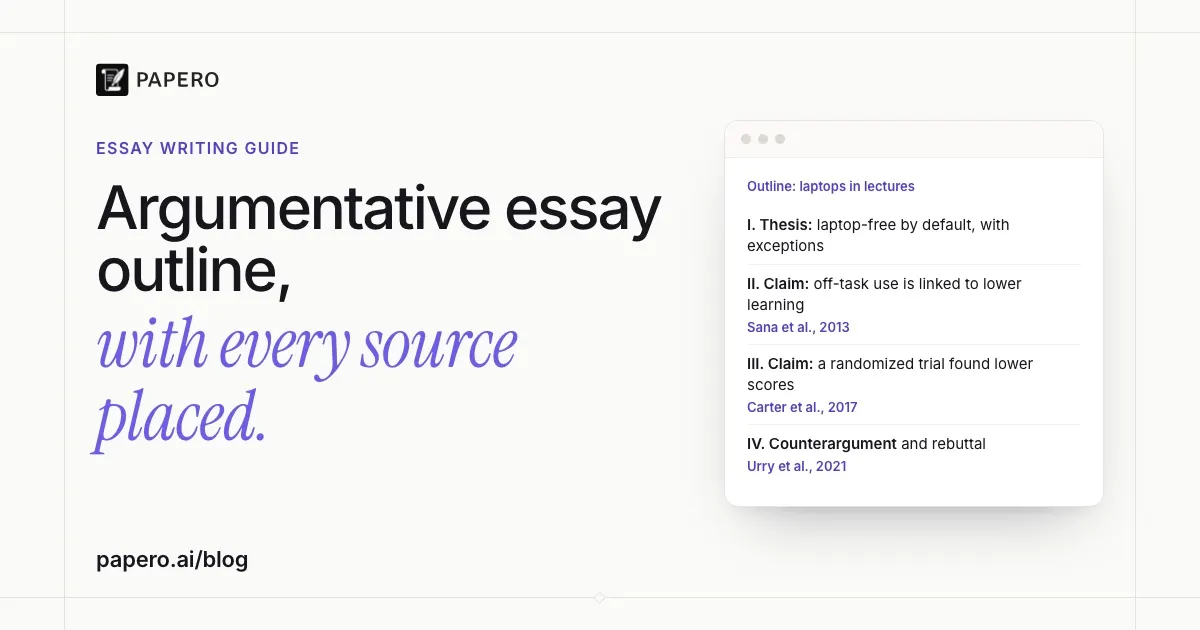
An argumentative essay outline has five parts: an introduction that ends in a thesis, two or three body paragraphs that each defend one claim with evidence, a paragraph that states the strongest objection and answers it, and a conclusion. Below is a template you can copy, then the same outline filled in with real, checkable studies on whether universities should ban laptops in lectures.
Key Takeaways
- Write the thesis first. Every other line of the outline exists to prove it, so a vague thesis produces a vague outline.
- Give each body paragraph one claim and at least one named source. If you cannot name the source yet, the outline has found a gap in your research, which is its job.
- The counterargument section is where marks are won or lost. State the opposing view at its strongest, then show why it does not overturn your thesis.
- The five-part structure is the default, not the only option. Toulmin and Rogerian models rearrange the same parts for different audiences.
What goes in an argumentative essay outline?
An argumentative essay outline lists, in order, the thesis, the claims that support it, the evidence for each claim, the main objection with your answer to it, and the conclusion. It is written in short phrases or single sentences, not paragraphs. Its purpose is to test whether the argument holds together before you spend hours drafting prose around it.
| Section | What it does | What to write in the outline | Share of a 1,500-word essay with two claims |
|---|---|---|---|
| Introduction | Sets up the debate and states your position | Hook, one line of context, the full thesis sentence | About 10-15% |
| Body paragraph 1 | Proves your strongest claim | Topic sentence, source and finding, one line on why it matters | About 25-30% |
| Body paragraph 2 | Proves the next claim | Same pattern as body paragraph 1 | About 25-30% |
| Counterargument and rebuttal | Answers the best objection | The objection, its evidence, your rebuttal and its evidence | About 15-20% |
| Conclusion | Shows what the argument adds up to | Thesis restated in new words, the implication | About 10% |
The shares are a starting point we use for planning, not a rule: a third claim takes its space from the other body paragraphs, and a brief that asks for a longer refutation, or a 3,000-word essay with four claims, changes them. What does not change is the order of logic. A reader should be able to cover the essay and reconstruct the argument from the outline alone.
Argumentative essay outline template
The template below is the classic five-part structure, with two body paragraphs and a separate paragraph for the counterargument. Copy it into your notes, replace every bracket with your own material, and keep each line to one sentence, so the outline stays short enough to check the logic at a glance.
- I. Introduction
- A. Hook: a fact, case or question that shows the issue matters
- B. Context: the debate in one or two sentences
- C. Thesis: [your position] because [reason 1] and [reason 2]
- II. Body paragraph 1: [reason 1, stated as a claim]
- A. Evidence: [author, year]: [what they found]
- B. Explanation: why this evidence supports the claim
- C. Link: how the claim supports the thesis
- III. Body paragraph 2: [reason 2, stated as a claim]
- A. Evidence: [author, year]: [what they found]
- B. Explanation: why this evidence supports the claim
- C. Link: how the claim supports the thesis
- IV. Counterargument and rebuttal
- A. Counterargument: the strongest opposing view, stated fairly
- B. Its evidence: [author, year]
- C. Rebuttal: why it does not overturn the thesis
- D. Rebuttal evidence: [author, year]
- V. Conclusion
- A. Thesis restated in new words
- B. What the two claims show together
- C. Implication: what should change, or what to watch next
Two habits make the template work. Write the thesis and every topic sentence as full sentences, because those are the lines your marker reads most closely. And attach a source to every evidence line now, while the outline is short. An evidence line that reads “[find a study]” is a research task, and it is better found today than at midnight before the deadline.
Argumentative essay outline example: should universities ban laptops in lectures?
Here is the template filled in. The topic is a real debate with research on both sides, and every study named below is peer-reviewed and has a DOI listed in the sources. The outline argues for a default ban; you could build an equally valid outline against one from the same studies.
- I. Introduction
- A. Hook: In 2014, a widely shared study reported that students who took notes on laptops did worse on conceptual questions than students who wrote by hand (Mueller & Oppenheimer, 2014).
- B. Context: Some lecturers ban laptops; others say bans punish students for a problem that research has not settled.
- C. Thesis: Universities should make lectures laptop-free by default, with exceptions for students who need a device, because off-task laptop use is linked to lower learning for users and the students around them, and a randomized trial found that allowing computers in class lowered exam scores.
- II. Body paragraph 1: Off-task laptop use is linked to lower learning, for users and for the people sitting near them.
- A. Evidence: Ravizza et al. (2017): non-academic internet use during lectures was common and was linked to lower class performance, even after accounting for intelligence, motivation and interest.
- B. Evidence: Sana et al. (2013): in a simulated lecture, students who multitasked on a laptop scored lower on a test, and so did peers in direct view of their screens.
- C. Explanation: the harm spreads beyond the student who chooses to browse, so it is not only a matter of personal choice.
- D. Link: a policy has to protect the students who are not multitasking.
- III. Body paragraph 2: Allowing computers caused lower exam scores in a controlled trial.
- A. Evidence: Carter et al. (2017): in a randomized trial at the United States Military Academy, sections that allowed computers had final exam scores 0.18 standard deviations lower. The drop also appeared where only tablets lying flat on the desk were allowed.
- B. Explanation: random assignment rules out the obvious objection that weaker students are the ones who choose laptops.
- C. Link: the effect is causal, so a default policy is justified.
- IV. Counterargument and rebuttal
- A. Counterargument: the longhand advantage has not held up. In a replication and extension, test performance did not consistently differ between longhand and laptop note-takers (Morehead et al., 2019), and a direct replication with mini meta-analyses found no reliable difference on factual or conceptual questions (Urry et al., 2021).
- B. Rebuttal: concede the point. The case in this essay does not rest on how notes are taken; it rests on distraction (Ravizza et al., 2017; Sana et al., 2013) and on a causal trial result (Carter et al., 2017), neither of which the replications tested.
- C. Rebuttal: a default ban with exceptions keeps devices available to students with accessibility needs.
- V. Conclusion
- A. Restated thesis: the strongest evidence against laptops concerns distraction and measured exam results, not typing, and a laptop-free default addresses both.
- B. Synthesis: harm to bystanders plus a causal trial result outweigh a weakened note-taking argument.
- C. Implication: universities should pair the default with clear, easy exceptions, and evaluate the policy with their own exam data.
Notice what the counterargument section does. It does not attack a weak version of the other side. It picks the most damaging evidence against the original 2014 finding, concedes that it is right, and then shows that the thesis never depended on it. That move, conceding a point and showing your argument survives, is what markers mean by “engaging with counterarguments”. For a wider view of how claims and evidence are judged, see the glossary entry on the argumentative essay.
How do you write a counterargument and rebuttal?
A counterargument is the strongest reasonable objection to your thesis; a rebuttal is your evidence-based answer to it. Find the objection by asking what a well-read opponent would say first, state it in terms they would accept, cite its best evidence, then either concede and show your thesis still stands, or show why the evidence does not apply.
There are three honest ways to rebut:
- Concede and narrow. Agree with the objection and show that your thesis does not depend on it, as the laptop outline does with the note-taking studies.
- Challenge the evidence. Show that the study behind the objection measured something else, used a sample that does not generalise, or has failed to replicate.
- Outweigh. Accept the objection as partly true and argue that your reasons matter more, with evidence for why.
What you cannot do is invent a weak objection and knock it down. Markers recognise a straw man quickly, and it signals that you did not read the other side. Placement is flexible: most essays put the counterargument just before the conclusion, but you can answer an objection inside the body paragraph it threatens.
Other ways to structure an argumentative essay
The five-part outline above is a simplified classical argument. Purdue OWL describes three established models, and each reorders the same building blocks for a different reader. Choose by audience: a hostile or divided audience often responds better to the Rogerian order, and an essay built around one tightly argued claim often fits Toulmin.
| Model | Order of parts | Use it when |
|---|---|---|
| Classical (Aristotelian) | Introduction, background, proposition, proof, refutation, conclusion | The default for most coursework; the template above is a compact version |
| Toulmin | Claim, data (grounds), warrant, backing, counterclaim, rebuttal | One central claim needs a tight logical case, as in policy or ethics essays |
| Rogerian | Introduction, the opposing view, where it is valid, your position, where yours applies, benefits to the other side | Your readers already disagree and need to feel heard before they will move |
In a Toulmin outline, the line most students skip is the warrant: the reason the evidence supports the claim. “Laptop users scored lower” is data; “so the laptop, not the student, caused the drop” is a warrant, and it needs backing, which is exactly why the randomized trial matters in the example. In a Rogerian outline, the section on where the opposing view is valid is not a formality. If it is thin, the essay reads as a classical argument with a polite opening.
How do you start the introduction of an argumentative essay?
Start with a hook that shows the debate is real, give the reader just enough context to follow it, and end the paragraph on your thesis. A specific fact, a case or a striking finding works better than a definition or a sweeping claim about history. Keep it short: the introduction promises the argument, and the body paragraphs deliver it.
The thesis carries most of the weight. A usable thesis takes a position someone could disagree with and names the reasons you will defend, as in “laptop-free by default, because of off-task harm and a trial result”. Our guide to essay introduction examples shows several opening patterns, and the glossary entries on the thesis statement and the hook define both terms.
How to turn the outline into a draft
Draft one section at a time, in outline order, and turn each line into one to three sentences. The claim line becomes the paragraph’s topic sentence. The evidence line becomes a sentence that names the source and reports the finding, usually in paraphrase with a citation like the ones in the example above (our guide to APA in-text citations covers the common author and page cases); keep block quotes for the rare passage whose exact wording is the evidence. The explanation line becomes the part most drafts leave out: why that finding proves the claim.
The glossary entry on the topic sentence shows how to phrase that first line so it states a claim rather than a topic.
Then check the joins. Each body paragraph should end by pointing back to the thesis, and the next should open with a transition that shows how its claim relates to the last one: adding to it, building on it or answering it. If you need evidence that is not yet in your outline, add it to the outline first. Students who write a literature review will recognise the same discipline: decide what each paragraph proves, then write it.
Where Papero fits
Papero is an AI writing workspace for students and researchers, and it is open: you can sign up free. Two of its features, as described on the Papero homepage, map onto the outline above. The outline builder turns a description of your paper into a two-level outline with a prompt for every section, which is a quick first pass at the claim, reasons and counterargument structure. And citation search finds real scholarly papers for the sentence you are writing, or looks one up by DOI, so each reason points to a source you can open and check.
The second one matters most for the counterargument section: search for papers on the objection you expect, read them, and answer the strongest one. Papero suggests and formats; the argument, the thesis and the decision about which objection to answer stay yours. The Free plan needs no card.
Frequently Asked Questions
How many paragraphs does an argumentative essay have?
The school default is five: an introduction, three body paragraphs and a conclusion, with the counterargument placed in the last body paragraph. The five-part outline in this guide has the same length but swaps the third claim for a separate counterargument paragraph. University essays are usually longer and organised by claim rather than by paragraph count, so a 2,500-word essay may give each claim two or three paragraphs. Follow the length in your brief and let the number of claims decide the rest.
Where does the counterargument go in an outline?
Most outlines place it after the body paragraphs and before the conclusion, so you answer the objection once your own case is on the table. The Rogerian model puts the opposing view near the start instead. You can also answer an objection inside the body paragraph it threatens, which works well when one claim attracts most of the disagreement.
What is the difference between an argumentative and a persuasive essay?
An argumentative essay wins with evidence and reasoning and must deal fairly with the opposing view. A persuasive essay can also use emotional appeal and may ignore the other side. In academic writing you are almost always asked for the first. The glossary entry on persuasive writing covers the overlap.
Should an argumentative essay outline use full sentences?
Use full sentences for the thesis and for each topic sentence, because their wording decides whether the argument is clear. Phrases are fine for evidence and explanation lines, as long as each one names its source. A full-sentence outline takes longer to write and saves more time when you draft.
Sources
- Carter, S. P., Greenberg, K., & Walker, M. S. (2017). The impact of computer usage on academic performance: Evidence from a randomized trial at the United States Military Academy. Economics of Education Review, 56, 118-132. https://doi.org/10.1016/j.econedurev.2016.12.005
- Morehead, K., Dunlosky, J., & Rawson, K. A. (2019). How much mightier is the pen than the keyboard for note-taking? A replication and extension of Mueller and Oppenheimer (2014). Educational Psychology Review, 31(3), 753-780. https://doi.org/10.1007/s10648-019-09468-2
- Mueller, P. A., & Oppenheimer, D. M. (2014). The pen is mightier than the keyboard: Advantages of longhand over laptop note taking. Psychological Science, 25(6), 1159-1168. https://doi.org/10.1177/0956797614524581
- Ravizza, S. M., Uitvlugt, M. G., & Fenn, K. M. (2017). Logged in and zoned out: How laptop Internet use relates to classroom learning. Psychological Science, 28(2), 171-180. https://doi.org/10.1177/0956797616677314
- Sana, F., Weston, T., & Cepeda, N. J. (2013). Laptop multitasking hinders classroom learning for both users and nearby peers. Computers & Education, 62, 24-31. https://doi.org/10.1016/j.compedu.2012.10.003
- Urry, H. L., Crittle, C. S., Floerke, V. A., Leonard, M. Z., Perry, C. S., III, Akdilek, N., Albert, E. R., Block, A. J., Bollinger, C. A., Bowers, E. M., Brody, R. S., Burk, K. C., Burnstein, A., Chan, A. K., Chan, P. C., Chang, L. J., Chen, E., Chiarawongse, C. P., Chin, G., … Zarrow, J. E. (2021). Don’t ditch the laptop just yet: A direct replication of Mueller and Oppenheimer’s (2014) Study 1 plus mini meta-analyses across similar studies. Psychological Science, 32(3), 326-339. https://doi.org/10.1177/0956797620965541
- Purdue OWL, Organizing Your Argument (owl.purdue.edu, accessed October 2026): https://owl.purdue.edu/owl/general_writing/academic_writing/establishing_arguments/organizing_your_argument.html