In this lesson you will
- Cover design, materials, procedure, measures and analysis
- Draft the section from a prompt that lists them
- Add the facts only you know: numbers, dates and instruments
A methods section says what you did, how you did it, with how many and why, in enough detail that someone else could repeat the study. Write it in the past tense. In Papero you list those parts in the Methods prompt, press Generate draft, then replace anything general with your own numbers, dates and instruments.
Write it so someone could do it again
A reader of the Methods asks one question: could I repeat this? For the microplastics study that means the fish (species, age, how many, from where), the particles (type, size, dose), the procedure (how long, how often, how growth was measured) and the analysis (which test, which software).
Use the past tense and report what you did, not what you planned: "The fish were fed twice a day" or "We fed the fish twice a day", in the voice your field uses. Give the reason for any choice a reader might question, such as why 28 days or why that dose.
Leave results out. The Methods says how you measured growth; the Results says what you found. When you used a method someone else published, such as an exposure protocol, cite it instead of describing it from scratch.
Lines to copy
- Section prompt, MethodsDesign: 28-day laboratory exposure, two groups. Fish: 60 juvenile zebrafish. Particles: polyethylene, size and dose. Measures: length and weight on day 0 and day 28. Analysis: t-test in R. Past tense.
- A sentence someone could repeatSixty juvenile zebrafish (Danio rerio, 30 days old) were split at random into a control group and an exposure group of 30 fish each.
- ChecklistWhat, how, how many, when, with what, analysed how, and why each choice.
In Papero
Set it up in Papero
Works on Free. On Free, section drafts are counted per day. If you have none left today, write the Methods yourself: as you type, Papero suggests how the sentence could go on.
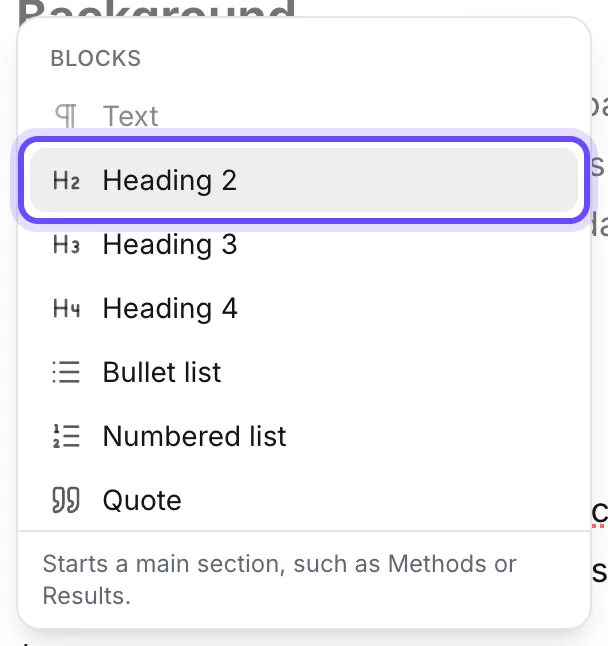
- If your paper has no Methods heading, type / on an empty line, choose Heading 2 and name it Methods. Its prompt box appears under Section prompts.
- Put your cursor in Methods. In its box, list the design, the materials or participants, the procedure, the measures and the analysis.
- Press Generate draft, read the draft and press Add to document or Discard.
- Go through it sentence by sentence. Replace every general phrase with your real numbers, dates, settings and instruments, and delete any figure you did not give in the prompt.
- Where you used someone else's method, put your cursor after that sentence and type @ after a space to cite it.
Practice
Your task
- Write the Methods prompt with the design, materials, procedure, measures and analysis.
- Draft the section, or write it yourself with suggestions, and keep it in the past tense.
- Add the details the AI cannot know: sample size, dates, instruments and settings.
You are done when your Methods names the sample size, the duration or dates, the instruments and the analysis, so another student could repeat the study from it.
Common mistakes
- Trusting the numbers in a draftThe draft knows only your prompt. A dose or a sample size you did not give it is a guess. Check every figure against your notes.
- Results in the Methods"Exposed fish grew less" belongs in the Results. The Methods says how you measured growth, not what you found.
- Too little to repeat"Fish were exposed to microplastics" leaves out which particles, how many and for how long. If a classmate would have to ask, add it.
Key points
- What, how, how many and why, in the past tense.
- Only you know the details, so add them yourself.
- Cite the methods you borrowed.
Up next · Lesson 10 of 20 · 7 min
Report your results with a table or a chart
One captioned table or chart, referred to in your text
Mark as done and continueYou marked this lesson as done.