In this lesson you will
- Group sources by theme instead of one paragraph per paper
- Get a cited first draft in the background, or work from your library by hand
- Write paragraphs that compare papers and lead to your gap
A literature review groups what other researchers found by theme, compares their results and shows where the evidence runs out. It does not summarise one paper per paragraph. In Papero, Draft a cited literature review writes a cited first draft as a new document and adds the papers it cites to your library. You then write your own review in your paper, theme by theme, citing each paper with @.
Synthesis, not summary
A summary goes paper by paper: one study found this, another found that. A synthesis goes idea by idea: three studies found that fish in polluted rivers take in more particles, two of them saw slower growth, and only one tested juveniles. The reader learns what the field knows, not what each paper says.
Start from your sources. For each paper, note its question, its fish, its method and its finding. Patterns appear quickly: four papers agree on uptake, two disagree on growth, none measured growth before adulthood. Each pattern is a theme, and each theme is a paragraph.
Inside a paragraph, compare. Use words that put papers side by side: both, unlike, in contrast, only one. Say why results differ when you can: another species, a higher dose, a shorter study.
End the review on the gap. The last paragraph says what no study has done yet, which is what your methods will do. That links the review back to the thesis at the end of your introduction.
Lines to copy
- Topic for a Workflows runHow microplastic exposure affects feeding and growth in juvenile freshwater fish
- Theme sentence, agreementSeveral laboratory studies report that fish exposed to microplastics eat less, although the size of the effect varies with particle size.
- Theme sentence, disagreementEvidence on growth is mixed: two studies found slower growth, while a third found none at a lower dose.
- Synthesis matrix columnsPaper | Question | Sample | Method | Finding | Theme
- Gap sentenceNone of these studies followed juvenile fish for more than two weeks, so it is not known whether early exposure affects later growth.
In Papero
Set it up in Papero
Works on Free. On Free, Workflows runs at Low depth and you get three runs for the life of the account, which do not come back. The setup dialog shows how many you have left. This task does not need one: writing the review by hand from your library uses no run.
- Press New in the sidebar and choose Draft a cited literature review. You can also press Workflows in the sidebar, then Set up on its card.
- Under Topic, describe your topic in one specific sentence. Keep Depth on Low: Medium and Max are part of Plus.
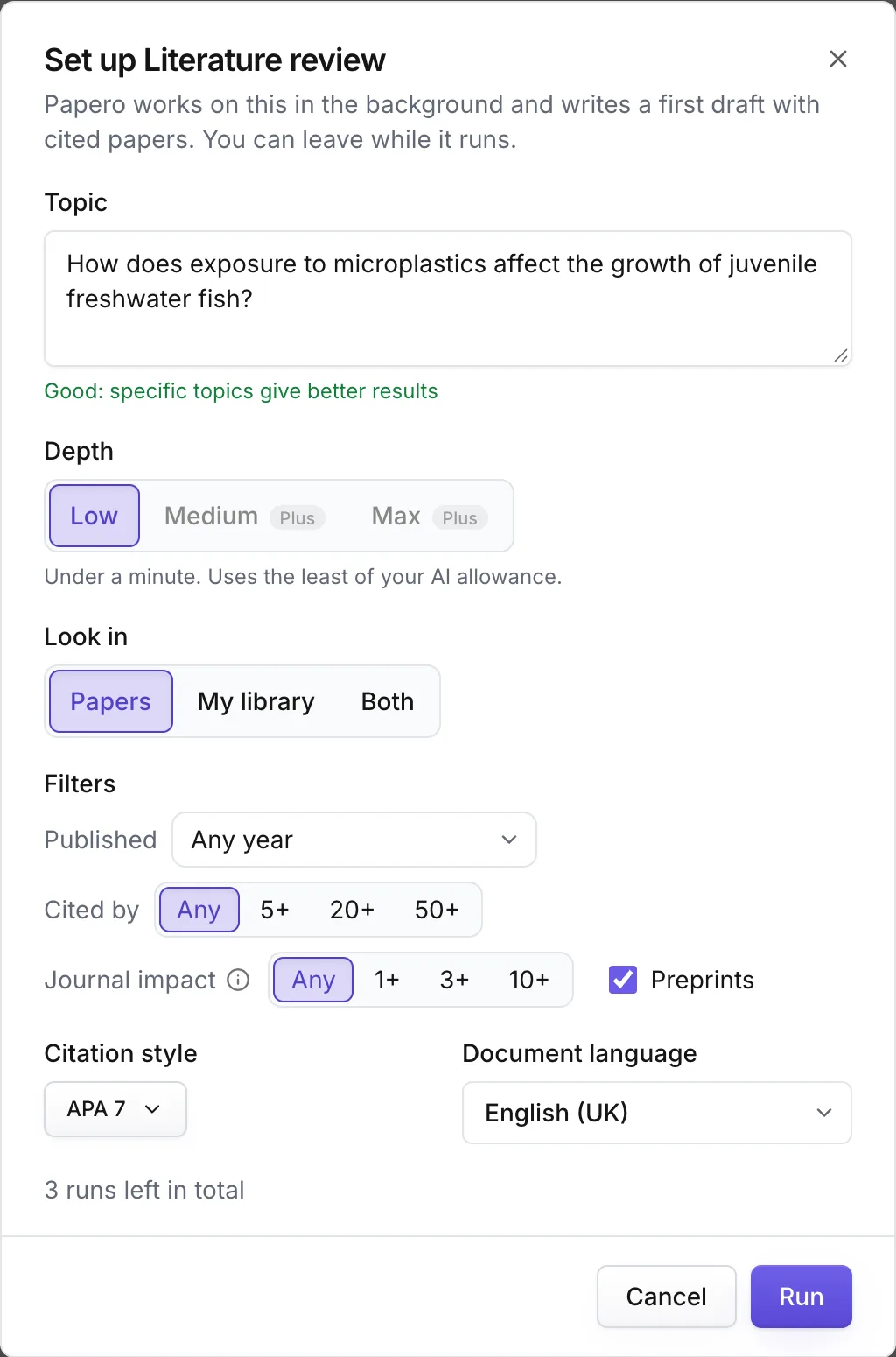
- Under Look in, choose Papers to search scholarly records, My library to use your own sources, or Both. Press Run. You can leave the page while it works.
- When it is done, open the new document and read it as a map. Its headings suggest themes, and the papers it cites are now in your library.
- Go back to your paper and put your cursor in the literature review section. Write one paragraph per theme. To cite, type @ after a space and pick the paper in the Library tab.
- By hand, without a run: open the papers in your library, note each one's finding, group them into themes and write the same paragraphs.
Practice
Your task
- List the papers you will use and group them into two or three themes, with a Low run of Draft a cited literature review as a map or by hand from your library.
- Write one paragraph per theme in your paper's literature review, comparing at least two cited papers you have read in each.
- End the section with a paragraph that states the gap your study fills.
You are done when each theme in your literature review has its own paragraph citing at least two papers, and the last paragraph states the gap.
Common mistakes
- One paragraph per paperThat is an annotated list, not a review. Group the papers by what they found, and let each paragraph make one point.
- Pasting the run's draft in as your reviewThe run writes about your topic, not about your paper. Use it to find themes and papers, write the review around your own question, and read every paper you cite.
- No gap at the endA review that just stops leaves the reader asking why your study is needed. Finish on what nobody has measured yet.
Key points
- Group by theme, then compare inside each theme.
- Every theme paragraph cites at least two papers.
- The review ends on the gap your study fills.
Up next · Lesson 9 of 20 · 6 min
Write a methods section someone could repeat
A Methods section another student could follow
Mark as done and continueYou marked this lesson as done.