In this lesson you will
- Tell a researchable question from one that is too broad or too narrow
- Rewrite your document prompt so that it ends with your question
- Change the headings until each one helps answer it
A research question names what you study, what you want to find out about it and in which setting, and it can be answered with evidence you can reach. Start from your topic and narrow it one limit at a time. In Papero, press Document prompt in the prompts panel, end the brief with your question, then edit the headings so each one helps answer it.
Narrow it until you can answer it
"Microplastics in freshwater fish" is a topic, and it could fill a shelf. A research question picks the part of it that a paper of your length can answer: "How does exposure to microplastics affect the growth of juvenile freshwater fish?"
Too broad: "Are microplastics bad for animals?" No paper can cover every animal and every harm. Too narrow: "Did the trout in one pond eat plastic fibres last March?" That is one observation, and you will not find studies to discuss it with. A good question sits between the two: one group, one effect, one setting, and enough published work to build on.
Test your question three ways. Can you name the kind of study that would answer it? Is the answer more than yes or no? Does every word mean one thing, so that "affect" becomes growth, feeding or survival? If a test fails, change one word and test again.
The question is also a filter. Each heading in your outline should help answer it, and each source you look for should speak to it. A heading that does neither belongs in another paper.
Lines to copy
- Question frame, effectHow does [exposure or cause] affect [outcome] in [group], in [setting]?
- Question frame, comparisonHow do [group A] and [group B] differ in [outcome], and why?
- Document prompt that ends with the questionA literature review for a master's dissertation in environmental science. Research question: how does exposure to microplastics affect the growth of juvenile freshwater fish?
In Papero
Set it up in Papero
Works on Free. Editing the prompt and the headings by hand uses no AI. Suggest headings uses one AI outline from your allowance. Free has one AI outline a day, so if you built your outline today, try this tomorrow.
- Open the document from the outline lesson. On a wider screen the prompts panel is on the left. If it is closed, press Show prompts panel.
- Press Document prompt at the top of the panel. The box holds the description you typed under What are you writing?.
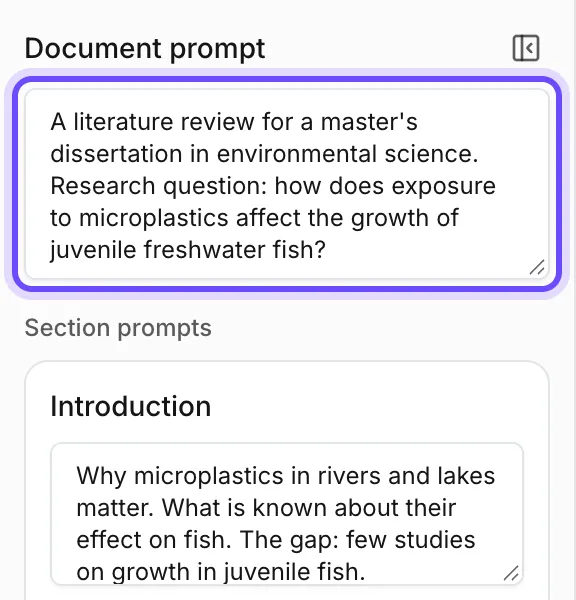
- Rewrite the brief so that it ends with your research question. Papero reads it when it drafts a section and when it suggests how a sentence could go on.
- If you want the question in the title as well, type it in the title at the top of the page.
- Read each heading and ask whether it helps answer the question. Rename it so that it does, or delete it.
- To find sections the question needs, press Document options, the three dots at the top right, and choose Suggest headings…. Press Suggest headings, read the list, and press Add to the end only if they fit.
Practice
Your task
- Write your research question with one of the frames, and test it: a study you can name, an answer longer than yes or no, no vague words.
- Put the question at the end of your document prompt.
- Rename or delete every heading that does not help answer it.
You are done when your Document prompt ends with one research question, and every heading in the prompts panel helps answer it.
Common mistakes
- A topic with a question mark"What about microplastics?" is still a topic. Name the group, the effect and the setting.
- A yes or no question"Do microplastics harm fish?" invites a one-word answer. Ask how, how much or under which conditions.
- Keeping headings from another paperA section on whales may be interesting, but it does not help a paper on freshwater fish. Cut it, or keep it for another paper.
Key points
- A topic names an area. A question names one thing to find out in it.
- One group, one effect, one setting: not too broad, not too narrow.
- The question decides your headings, and next your sources.
Up next · Lesson 4 of 20 · 7 min
Find five papers worth citing
Five sources in your library, two of them with their PDF
Mark as done and continueYou marked this lesson as done.