In this lesson you will
- Judge a paper from its abstract and a few facts in two minutes
- Search with the words of your research question and narrow the results
- Save five papers to your library, two of them with their PDF
A paper is worth citing when it answers part of your question, comes from a source you can trust and is one you have read. Judge each one on five things: relevance, date, peer review, how often it is cited and whether it is an original study or a review. In Papero, press Find papers in the sidebar, search with the words of your question, then press Save to library or Save with PDF on the papers that pass.
Five questions for every paper
Relevance comes first. Read the title, then the abstract. Does the paper study your group and your outcome? A study on sea fish may help a paper on freshwater fish, but only in the background.
Then the date and peer review. Recent work shows where the field is now, while an older paper may be the one everyone builds on. A preprint has not been through peer review yet, so look for a published version first.
Then citations and the type of study. A high citation count shows that others use a paper, not that it is right, and a paper from this year has had no time to be cited. Know whether you hold a primary source, which reports a study, or a secondary one, such as a review, which sums up many. A review is a good map of the field. For a specific finding, cite the study that found it.
For the microplastics question, a sound first five is one or two recent reviews to map the field and three original studies that measured growth in freshwater fish.
Lines to copy
- Search words from the questionmicroplastics juvenile freshwater fish growth
- Search words for a reviewmicroplastics freshwater fish review
- Note to yourself on each paperStudy type: laboratory experiment. Fish: juvenile carp. Finding: slower growth after exposure. Use it for: what earlier studies found.
In Papero
Set it up in Papero
Works on Free. Each search counts toward your paper search allowance, and Free has a daily limit, so choose your words before you search. Papero may ask you to confirm your email address before you search, get a free PDF or upload one.
- Press Find papers in the sidebar. Type words from your research question and press Search.
- Press Filters to narrow the results: a year under Published from, a minimum under Cited by, a minimum under Journal impact, or untick Preprints. To change the order, switch Relevance to Most recent or Most cited.
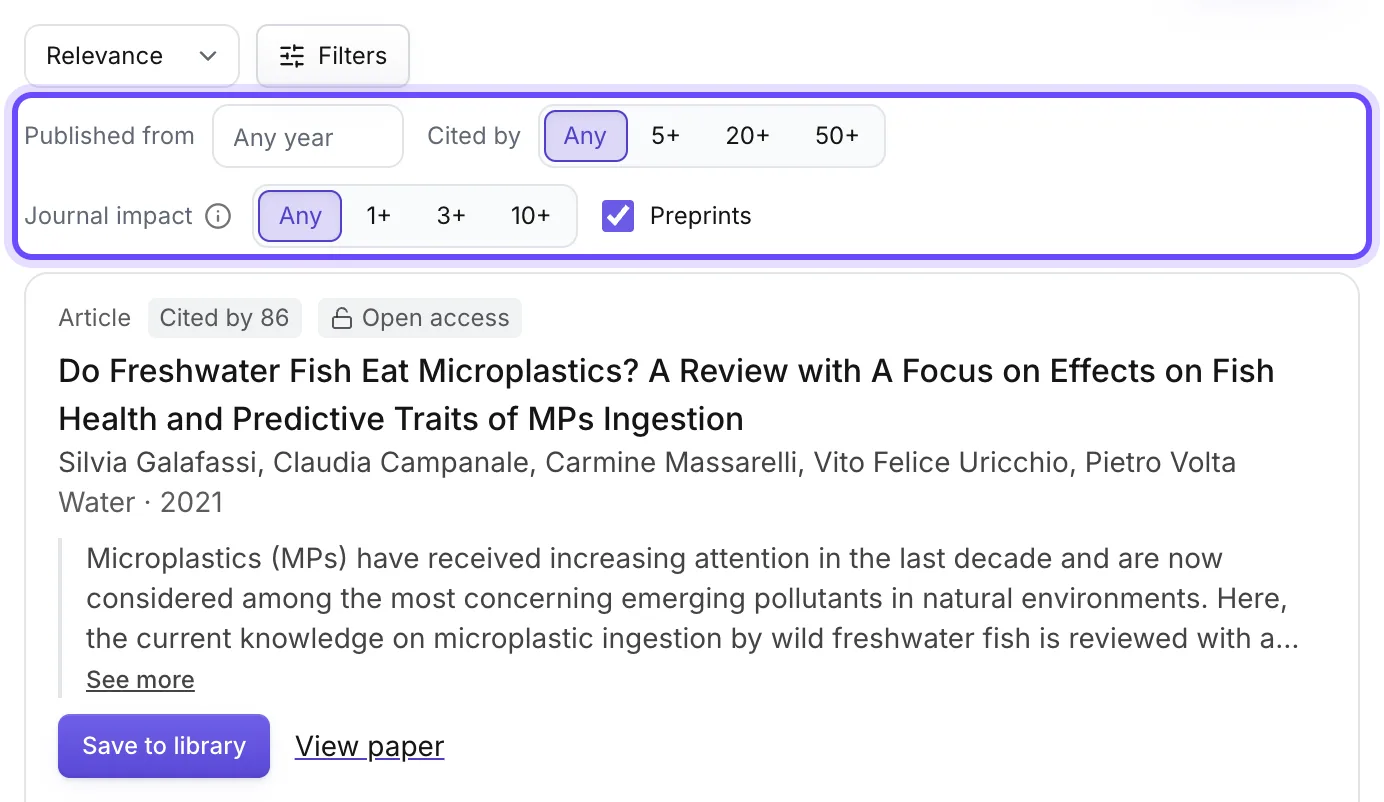
Paper shown: Galafassi, Campanale, Massarelli, Uricchio and Volta (2021), Water 13(16), 2214, https://doi.org/10.3390/w13162214, CC BY 4.0; abstract shortened. - Read each card: the type of paper, Cited by and a number, and Preprint, Retracted or Open access when they apply. Press See more to read the whole abstract.
- Press Save to library on a paper that passes your five questions. The card then shows Saved.
- When a card offers Save with PDF, the paper has a free copy. Press it to save the paper and fetch the PDF. Papero says PDF added. when it is in. If the publisher blocks the download, Papero offers Upload PDF for a copy you have.
- For a paper you already have as a file, press Library in the sidebar, then Choose PDFs. Papero reads the PDF and fills in the paper from its DOI.
Practice
Your task
- Search with the words of your research question, and use at least one filter.
- Save five papers that pass the five questions: one or two reviews and at least three original studies.
- Get the PDF of two of them, with Save with PDF or from a file you have.
You are done when your Library lists five new sources, and two of them show a PDF badge with their number of pages.
Common mistakes
- Saving only papers that agree with youA review that leaves out the studies that found no effect is not a fair map. Save the strongest papers on each side.
- Taking citations for qualityMany citations mean many readers, not a sound method. A strong paper from this year can show very few.
- Saving only reviewsReviews are a map. When you cite a finding, cite the study that found it.
Key points
- Relevance, date, peer review, citations, type of study.
- Search with the words of your question, then narrow with filters.
- Save on purpose: five papers you can say why you kept.
Up next · Lesson 5 of 20 · 6 min
Bring in the references you already have
Every reference for your paper in one library
Mark as done and continueYou marked this lesson as done.