In this lesson you will
- Plan an introduction in four moves: context, what is known, the gap and your aim
- Draft the introduction from its section prompt
- End it with one thesis sentence in your own words
A research paper introduction moves from wide to narrow: why the topic matters, what is already known, what is missing and what your paper does about it. It ends with a thesis statement, one sentence that says what you argue or test. In Papero you write those four moves into the introduction's section prompt, press Generate draft, then rewrite the last sentence yourself.
The funnel and the sentence at the end
Think of the introduction as a funnel. Start with context a reader in your field accepts: plastic waste reaches rivers and lakes, and fish take in the particles. Narrow to what studies have found, with a citation for each finding. Then name the gap: most work is on adult fish, and few studies measure growth in juveniles. The last move is your answer to that gap.
That last move is the thesis statement. In a research paper it states your aim or your claim in one sentence: "This study tests whether juvenile fish exposed to microplastics grow more slowly than unexposed fish." A reader should be able to guess your methods from it. "This paper looks at microplastics" fails that test, because it names a topic, not a claim.
Put the gap and the thesis next to each other and make them match. If the gap is growth in juveniles, the thesis is about growth in juveniles. A thesis that answers a different gap is the first thing a marker notices.
The thesis can change as you write. Draft it now and read it again after the discussion: the final version should promise what the paper delivers, no more.
Lines to copy
- Section prompt, introduction in four movesContext: plastic waste in rivers and lakes, and why fish matter. Known: two or three findings on how fish take in microplastics. Gap: few studies on growth in juvenile fish. Aim: my research question, in the last sentence.
- Thesis frame, a studyThis study tests whether [what you change or compare] affects [what you measure] in [who or what], using [how].
- Thesis frame, an argumentI argue that [claim], because [first reason] and [second reason].
- Example thesisThis study tests whether juvenile zebrafish fed microplastic particles for 28 days grow more slowly than fish in a control group.
In Papero
Set it up in Papero
Works on Free. On Free, section drafts are counted per day, and the panel shows how many you have left under Generate draft. If you have none left today, write the introduction yourself from the four lines.
- If you already drafted the introduction in the lesson on your first cited paragraph, skip the draft: sort your text into the four moves below, then go to the last step.
- Open your paper and put your cursor in the introduction. Its prompt box opens under Section prompts. If the panel is closed, press Show prompts panel.
- Replace the prompt with four short lines, one for each move: context, what is known, the gap and your aim.
- Press Generate draft and read the draft. Press Add to document to keep it, or Discard to drop it. If the introduction already has text, the draft carries on from where your text ends.
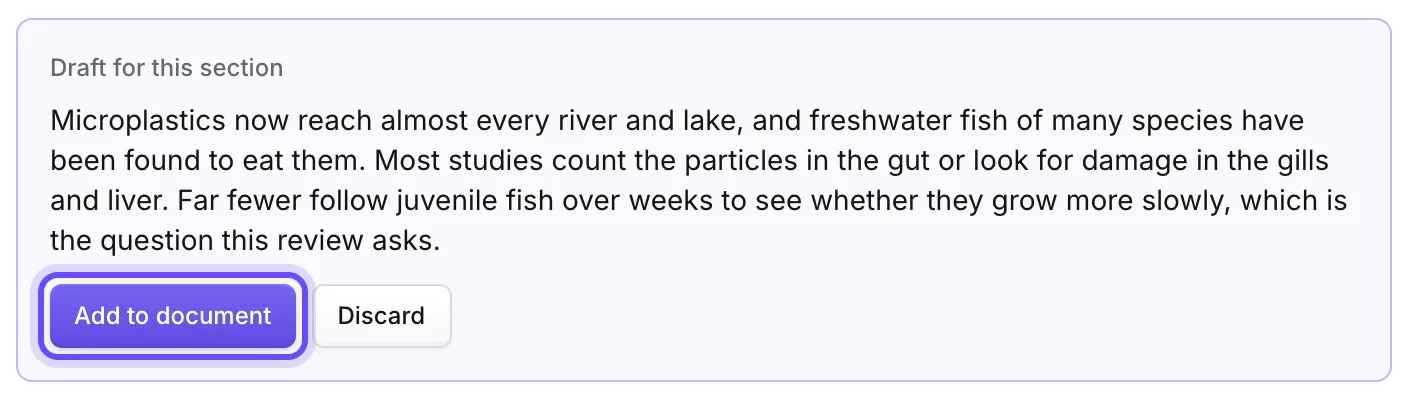
- Read the part on what is known. Keep a finding only if you can cite a paper that says it: open the paper to check, cite it by typing @ after a space at the end of the sentence, and delete the rest.
- Read the last sentence. Rewrite it as one sentence that states what your paper tests or argues.
Practice
Your task
- Write the introduction's prompt in four lines: context, what is known, the gap and your aim.
- Draft the introduction or write it yourself, and keep a finding only when a paper you opened says it.
- Rewrite the last sentence into one thesis sentence of your own, and check that it answers the gap just before it.
You are done when your introduction ends in one thesis sentence that says what you test or argue, right after the sentence that states the gap.
Common mistakes
- A thesis that only names the topic"This paper is about microplastics" promises nothing a reader can check. Say what you test or argue, in whom and how.
- A gap the thesis does not answerIf the gap is growth in juveniles and the thesis is about survival in adults, the introduction points one way and the paper goes another. Make the two match.
- Starting too wide"Plastic is everywhere" spends your first line on what nobody doubts. Start with the context your reader needs for this paper.
Key points
- Context, what is known, the gap, your aim: four moves from wide to narrow.
- The thesis is one sentence that states your claim or your aim.
- The gap and the thesis must match.
Up next · Lesson 8 of 20 · 7 min
Write a literature review that compares your sources
A literature review grouped by theme that ends on the gap
Mark as done and continueYou marked this lesson as done.