In this lesson you will
- Tell a paraphrase from patchwriting
- Restate a passage in your own words and keep its citation
- Decide when a quote serves better than a paraphrase
To paraphrase without plagiarising, read the passage, close the source and write the point in your own words and your own sentence structure. Then cite the source, because the idea is still not yours. If your sentence still follows the source, write it again from memory or quote the words you kept. In Papero, Paraphrase under Rewrite is for smoothing a sentence that is already yours: press Accept only if it keeps your meaning, and the preview tells you if a version leaves a citation out.
New words, new structure, same meaning, same citation
A paraphrase restates what a source says in your words and in a sentence you built yourself. The meaning stays exactly the same, and so does the credit: a paraphrase needs a citation just as a quote does. Done well, it shows your marker that you understood the source, which a quote cannot.
Patchwriting is the trap. You keep the source's sentence and swap in synonyms: "showed reduced growth rates" becomes "showed lower growth rates". The structure is still the author's, and many universities treat it as plagiarism even with a citation. The fix is a method: read the passage, close it, write the point from memory, then open the source again and check.
Some things should not be paraphrased. Figures stay exact. Technical terms such as microplastics have no fair synonym, so keep them. When the exact wording matters, because you analyse it, challenge it or build on a definition, quote it instead and mark it as a quote.
A rewrite tool changes words. It does not know where an idea came from, and it cannot make copied wording your own. Use it on a sentence you wrote from your own reading, then check the result against the source before you keep it.
Lines to copy
- Source passage (an example)Juvenile fish exposed to high concentrations of microplastics showed reduced growth rates compared with unexposed controls.
- Patchwriting: too close to the sourceYoung fish exposed to high levels of microplastics showed lower growth rates than unexposed controls (Author et al., year).
- A real paraphraseIn juvenile fish, heavy exposure to microplastics slowed growth compared with fish that were not exposed (Author et al., year).
In Papero
Set it up in Papero
Works on Free. A rewrite counts toward your allowance only when you press Accept, and the Rewrite list shows how many you have left.
- Read the passage in the source until you can say its point without looking. Then close it.
- Write the point in your own sentence. Put your cursor at the end of the sentence, press Cite and cite the paper, as in the lesson on your first cited paragraph.
- If your sentence still follows the source's wording, close the source and write it again from memory, or quote the words you kept. If your course limits AI help, check its rules first, and declare what you used in your AI use statement.
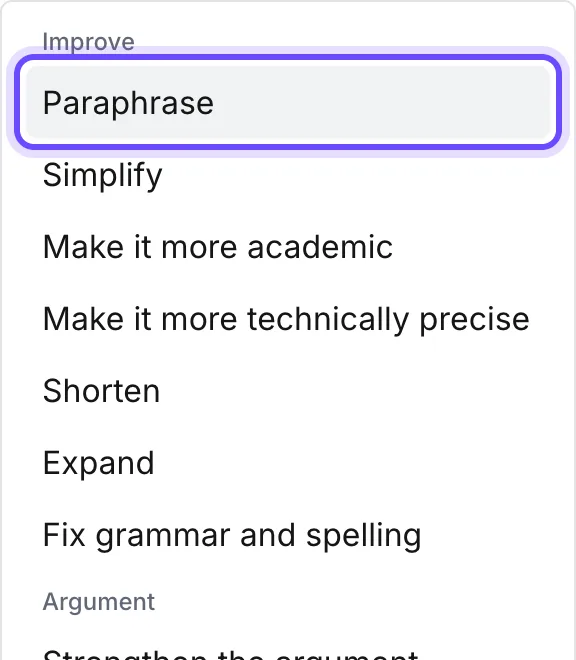
- To smooth a sentence that is already yours, select it and press Rewrite in the small menu that appears, or press Ctrl+J, which is Cmd+J on a Mac. Under Improve, choose Paraphrase.
- Read the version next to the source. When the paper's PDF is in your library, click the citation and press Show in PDF to open the paper at the passage closest to your sentence.
- Press Accept if the version keeps your meaning and still reads like you, Try again for another version, or Discard to keep your own.
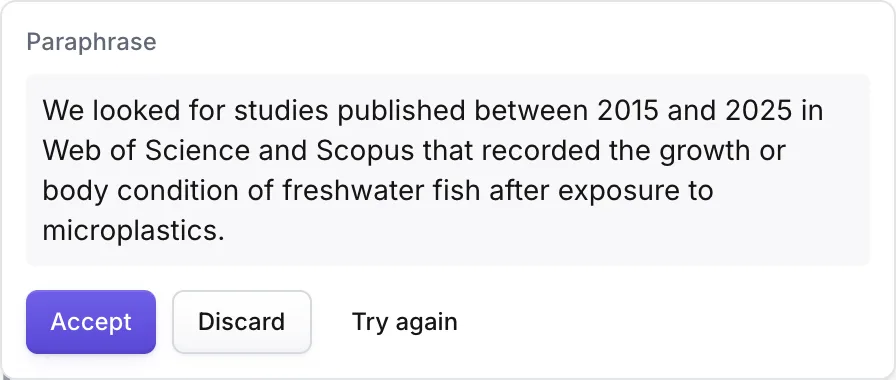
- Check that the citation is still at the end of the sentence. If a version leaves a citation out, the preview says so, and Discard keeps your original with the citation in it.
Practice
Your task
- Pick one passage from a source you cite and write its point from memory, in your own words.
- Compare your sentence with the source. Apart from technical terms and names, change any run of three or more words that matches, or quote those words.
- If it still sounds like the source, rewrite it yourself from memory. Use Paraphrase only to smooth your own sentence, and keep the citation.
You are done when one passage in your document restates a source in your own words and structure, and its citation is still at the end of the sentence.
Common mistakes
- Swapping synonyms into the source's sentenceThe same structure with new words is patchwriting. Change the structure too, or quote the words.
- Leaving out the citationA paraphrase is still someone else's idea. It needs the same citation a quote would.
- Paraphrasing the source's own text with a toolPasting a passage from a paper and pressing Paraphrase gives you reworded text, not understanding, and the idea still belongs to the source. Write from your own reading first, then rewrite your own sentence.
Key points
- New words and new structure, same meaning, same citation.
- Read, close the source, write, then check back.
- Quote when the exact words matter.
Up next · Lesson 13 of 20 · 6 min
Write in an academic tone
One section in an academic register
Mark as done and continueYou marked this lesson as done.