In this lesson you will
- Spot contractions, filler and vague verbs in your own draft
- Hedge a claim as far as its evidence asks, and no further
- Bring one section into an academic register with a checklist and a rewrite
An academic tone is formal, precise and careful: no contractions or slang, verbs that say exactly what a study did, and claims hedged as far as the evidence requires. Go through one section with a checklist first. In Papero, select a paragraph that still sounds casual, press Rewrite, open Change tone and choose Academic, then read the version before you press Accept.
Formal is not the same as complicated
Register is the level of formality. "Fish don't do well with lots of plastic" is how you would say it to a friend. "Juvenile fish exposed to high concentrations of microplastics grew more slowly" is how a paper says it. Take out contractions, slang and vague words such as "a lot of", "things" and "really". Cut filler openers such as "It is important to note that". Long words for their own sake do not help: "use" is as academic as "utilise".
Choose verbs that say what was done. "The study looked at fish" is vague. "The study measured growth in 200 juvenile carp" tells the reader what happened. Reporting verbs carry strength too: a study shows, suggests or claims, and each tells the reader how far you trust it.
Hedging means stating a claim with the certainty the evidence supports. One laboratory study supports "microplastics may reduce growth in juvenile fish", not "microplastics kill fish". But a paper that hedges everything sounds unsure of itself. "This could possibly suggest" says the same thing three times. Hedge once, where the doubt is real.
First person depends on your field. APA 7 and many science journals accept "we measured" or "I argue" for what you did and decided, while some departments still want the passive voice in methods. Check your handbook, and never use "I feel" in place of evidence.
Lines to copy
- Checklist for one sectionNo contractions (don't, it's, can't). No chatty words (a lot of, pretty, huge, stuff). No filler openers (It is important to note that, In today's world). Verbs say what was done (measured, compared, reported). Each hedge matches its evidence. First person only where my field uses it.
- BeforeLots of studies have looked at plastic in fish and it's pretty clear it's a big problem.
- AfterSeveral studies have examined microplastics in freshwater fish, and most report effects on feeding or growth (Author et al., year; Author, year).
- Hedges to choose fromThese results suggest that ... / One explanation may be that ... / In this sample, ... was associated with ... / The evidence so far is limited to ...
In Papero
Set it up in Papero
Works on Free. A rewrite counts toward your allowance only when you press Accept, and the Rewrite list shows how many you have left.
- Read one section with the checklist above beside it, and fix what you can by hand first.
- To find contractions, press Ctrl+F, which is Cmd+F on a Mac, or open Document options and choose Find and replace, then search for "n't". Curly and straight apostrophes both match.
- Select a paragraph that still sounds casual and press Rewrite in the small menu, or press Ctrl+J.
- Under Change, open Change tone and choose Academic. Make it more academic under Improve is the other way: it raises the formality and keeps a similar length.
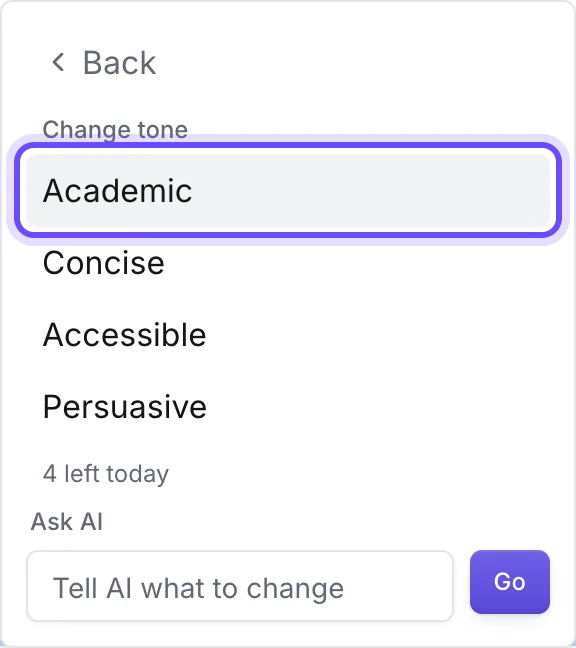
- Read the version. Press Accept if it says the same thing in a better register, Try again for another version, or Discard to keep yours.
- For a claim that is stronger than its evidence, select it and choose State it more cautiously under Argument. Check the result against the source: a firm finding should stay firm.
Practice
Your task
- Pick one section and read it against the checklist, fixing contractions, filler and vague verbs by hand.
- Rewrite one paragraph that still sounds casual with Change tone and Academic, and keep only what you agree with.
- Read every hedge in the section and keep it only where the evidence calls for it.
You are done when Find shows no "n't", "it's", "'re" or "'ve" in that section, and you can say why each hedge in it is there.
Common mistakes
- Long words for their own sakeFormal is not grand. A clear sentence with plain, exact words reads as more academic than a padded one.
- Hedging everything"May possibly suggest" sounds unsure of everything. Keep one hedge, where the doubt is real.
- Accepting a rewrite that changes the claimA rewrite toward a formal register can make a claim firmer or softer than its source. Compare it with the source before you press Accept.
Key points
- Formal, precise, careful: no contractions, exact verbs, honest hedges.
- Hedge as far as the evidence asks, and no further.
- First person follows your field and your handbook.
Up next · Lesson 14 of 20 · 6 min
Quote a source with a signal phrase and a page number
One short quote, introduced and cited with its page
Mark as done and continueYou marked this lesson as done.